Executive Intelligence Snapshot
This report analyses recent developments surrounding the expansion of the Caspian Coastal Cluster in Derbent District, including plans for investment exceeding RUB 100 billion and the continued allocation of federal and regional funding to supporting infrastructure.
The assessment examines how these initiatives reflect the Russian government’s broader strategy to promote tourism as a driver of socioeconomic development in Dagestan and the wider North Caucasus.
Tourism and associated infrastructure development have become priority sectors within regional development policy; however, the continued availability of investment lots suggests that investor appetite remains below the level sought by authorities, highlighting persistent concerns regarding the North Caucasus investment environment.
Context
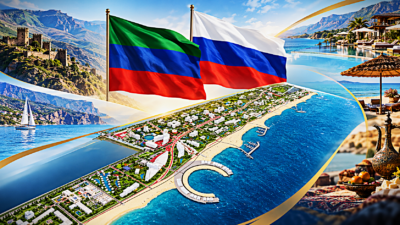
On 28 October 2026, Acting Minister of Tourism and Folk Arts of Dagestan Emin Merdanov announced that the projected investment volume for the Caspian Coastal Cluster in Derbent District had increased from an initially planned RUB 70 billion to more than RUB 100 billion. According to regional authorities, investment agreements worth RUB 61.2 billion have already been signed, while twelve investment lots remain available. The project covers approximately 400 hectares and includes plans for 28 hotels and sanatoriums comprising 7,200 rooms, six kilometres of developed coastline, and multiple recreation and family leisure facilities.
The project is being supported through a combination of private investment and public funding. Sixteen investors have obtained resident status within the Special Economic Zone and are currently engaged in project development and design activities.
In parallel, the state development institution Kavkaz.RF plans to invest RUB 14.4 billion in the cluster’s internal infrastructure by 2027 under the federal programme Five Seas and Lake Baikal, while the Republic of Dagestan has allocated RUB 4.4 billion to road infrastructure connecting the resort to the federal transport network. Authorities also reported that resident projects have received approval for RUB 16.5 billion in preferential loan financing.
Why Does It Matter?
The increase in projected investment from RUB 70 billion to more than RUB 100 billion reinforces the assessment that Russian authorities regard the Caspian Coastal Cluster in Derbent District as a strategically important development project and a potential long-term economic driver for Dagestan.
This development confirms the continued prioritisation of tourism and recreation within Moscow’s approach to regional development, supported by both federal financing mechanisms and regional infrastructure spending.
More broadly, the project reflects a long-standing Russian policy of using tourism-led development to stimulate economic growth and improve socioeconomic conditions across the North Caucasus. Following the launch of the North Caucasus Socioeconomic Development Strategy 2025 and the Kurorty Severnogo Kavkaza (North Caucasus Resorts) initiative in 2010, tourism has increasingly been positioned as a key sector for attracting investment, generating employment and supporting regional modernisation. The additional resources allocated to the Caspian Coastal Cluster demonstrate the continued relevance of this policy approach.
The development also highlights the geoeconomic significance of Derbent District. Located on the western shore of the Caspian Sea, where the Caucasus Mountains approach the coastline, the area has historically served as a strategic transit corridor known as the “Caspian Gate”. Historically, important trade routes, including sections of the Silk Road, passed through this corridor.
In the contemporary context, the district remains strategically positioned along transport routes connecting Russia with the South Caucasus, Central Asia and Iran. Its integration into the International North-South Transport Corridor (INSTC) further enhances its significance, as the development of this network is intended to expand Russia’s foreign economic connectivity and facilitate trade with markets to the south. The district’s proximity to Azerbaijan also places it at the intersection of economic, security and diplomatic considerations.
This development suggests that Moscow’s efforts along the Dagestani coast extend beyond tourism alone and form part of a wider strategy to increase the economic attractiveness and connectivity of the republic. While authorities are promoting resort construction, hotel development and the exploitation of the region’s cultural and natural attractions in Derbent District, parallel investments in Makhachkala have focused on expanding the operational capacity of the Makhachkala Sea Trade Port and strengthening Dagestan’s role within Caspian maritime trade and the INSTC. Collectively, these developments indicate an integrated approach aimed at positioning Dagestan as both a tourist destination and a logistics hub linking Russia with markets across the Caspian region and beyond.
At the same time, the continued availability of twelve investment lots suggests that investor demand has not yet matched the ambitions of regional authorities. This information supports the assessment that, despite substantial state backing, concerns regarding the investment climate, business environment and perceived risks associated with the North Caucasus continue to constrain the pace of private-sector participation.
Outlook
In the short term, it is highly likely that Dagestani and Russian authorities will continue to promote investment opportunities within the Caspian Coastal Cluster in Derbent District. Securing investors for the remaining twelve investment lots is likely to become a priority objective, with authorities expected to utilise national investment platforms and business events, including future editions of the Caucasus Investment Forum, to attract additional capital and increase private-sector participation.
In the medium term, the continued expansion of tourism facilities, transport infrastructure and supporting services along the Dagestani coast is likely to strengthen the republic’s position within Moscow’s regional development strategy. Current indicators suggest that the authorities intend to integrate tourism, logistics and transport development into a broader effort to enhance Dagestan’s economic role within the North Caucasus and the Caspian region. Should current investment and infrastructure programmes proceed as planned, Dagestan could assume a more prominent position as both a tourism destination and a transport gateway linked to the International North-South Transport Corridor.
However, several constraints may limit the success of the Caspian Coastal Cluster and the wider Russian development strategy in Dagestan. Western sanctions may reduce opportunities to attract foreign investors, international partners and external financing. In addition, Dagestan’s continued reliance on federal funding highlights the limited capacity of the regional economy to independently sustain large-scale infrastructure and development projects. This dependence could increase the vulnerability of ongoing projects to changes in federal budget priorities or broader economic conditions.
Security and social stability will also remain important variables. Although the region has experienced a significant reduction in terrorist violence compared with previous decades, extremist organisations continue to target Dagestan and, in general, the North Caucasus through propaganda and recruitment efforts. At the same time, previous episodes of public dissatisfaction and local protest demonstrate that socioeconomic grievances and controversial policy decisions retain the potential to generate domestic tensions.
Consequently, continued monitoring should focus on investment inflows, project implementation, federal funding commitments, the regional security environment and local public sentiment, all of which are likely to influence the long-term viability of the Caspian Coastal Cluster.
