Executive Intelligence Snapshot
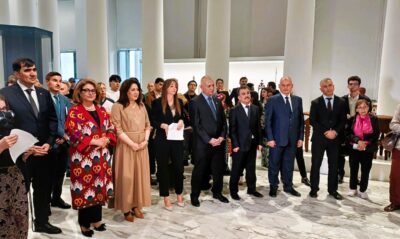
The opening of Tajikistan – The Land of Unique Heritage at Rome’s Museo delle Civiltà on 20 October 2026 provided an opportunity to assess Tajikistan’s cultural diplomacy within the broader development of Italy–Central Asia relations.
SpecialEurasia attended the event, met Tajik representatives and engaged with diplomats from other Central Asian countries and the post-Soviet space, gathering first-hand perspectives on the region’s diplomatic and cultural environment.
Information Background
The exhibition Tajikistan – The Land of Unique Heritage opened on 20 October 2026 at the Museo delle Civiltà in Rome and is scheduled to run until 20 January 2027. The initiative forms part of the commemorations marking the 35th anniversary of Tajikistan’s independence.
Organised by the National Museum of Tajikistan in cooperation with the Museo delle Civiltà, the exhibition presents approximately 80 historical and cultural artefacts dating from the sixth century BCE to the twentieth century CE. The collection includes archaeological discoveries from Takht-i Sangin, ancient Panjakent and Ajina-Teppa, alongside traditional crafts, textiles, chakan embroidery and musical instruments. An English-language catalogue accompanies the exhibition.
Among the Italian and Tajik authorities who participated in the event there were Matlubakhon Sattoriyon, Minister of Culture of Tajikistan, Ibrohimzoda Zafarsho Safo, Director of the National Museum of Tajikistan, Luana Toniolo, Director of the Museo delle Civiltà, Jamoliddin Ubaidullo, Ambassador of Tajikistan to Italy, acknowledged for his contribution.
The exhibition follows the first Italy–Central Asia Summit in May 2025 and the first EU–Central Asia Summit in March 2025, reflecting growing European interest in the region.
SpecialEurasia’s participation provided an opportunity to meet Tajik representatives and engage with diplomats from other Central Asian countries and the post-Soviet space who attended the event. These exchanges offered an additional perspective on the diplomatic environment surrounding Tajikistan’s cultural outreach and the wider regional context in which such initiatives take place.
SpecialEurasia’s presence forms part of its continuing research into Central Asia, building on the agency’s 2025 publication of “Geopolitica dell’Asia centrale”, a book written in Italian for the Italian-speaking audience
Analysis
The exhibition is part of a broader expansion of Italy’s engagement with Central Asia rather than as an isolated cultural initiative. Italy–Tajikistan relations have gained momentum since President Emomali Rahmon’s official visit to Italy in 2024. Cooperation encompasses energy, industry, infrastructure, textiles, environmental protection and tourism.
Italian participation in the Rogun hydropower project, alongside commercial activity in Tajikistan’s textile sector, illustrates the potential for Italian technical expertise and investment to support Dushanbe’s development priorities.
The October 2026 visit to Tajikistan by Italian Deputy Foreign Minister Edmondo Cirielli, during which the two sides discussed energy, connectivity, water resources and commercial cooperation, further demonstrates Rome’s continuing diplomatic engagement.
Cultural diplomacy complements these political and economic relations. For Italy, the exhibition strengthens institutional engagement with Tajikistan and contributes to a wider regional approach combining commercial interests with diplomatic and cultural initiatives. For Dushanbe, it offers a platform to promote national heritage, broaden European contacts and raise the profile of its tourism sector. Its longer-term significance will depend on whether the relationships established through cultural initiatives lead to sustained institutional cooperation and practical economic outcomes.
Tajikistan occupies a strategically significant position on the Eurasian geopolitical chessboard, where competition among established powers and emerging partners is reshaping regional alignments, access to markets and transport corridors.
Bordering Afghanistan and China, and closely connected to Russia through security arrangements, labour migration and economic ties, Dushanbe sits at the intersection of several strategic interests.
Russia retains substantial security and political influence, while China has expanded its role through infrastructure financing, mining, trade and security cooperation. The United States is seeking to strengthen its position: during his October 2026 visit to Samarkand, Secretary of State Marco Rubio met the foreign ministers of all five Central Asian republics under the C5+1 framework, promoting US commercial opportunities and strategic engagement, although the immediate deliverables were comparatively modest.
Meanwhile, Turkey, India, the Gulf Arab states and Iran offer additional channels for economic, diplomatic and security cooperation, further complicating the regional balance.
For Tajikistan, as well as for all the Central Asian republics, this increasingly multipolar environment creates opportunities to diversify investment, trade and diplomatic partnerships without abandoning established relationships; for external powers, the country forms part of a wider contest for influence, access to emerging markets, critical resources and strategic connectivity across Central Asia.
Conclusion
The Rome exhibition illustrates how cultural diplomacy can complement Italy’s expanding engagement with Central Asia while supporting Tajikistan’s efforts to broaden its international partnerships.
In the short term, further diplomatic, cultural and academic exchanges are plausible; over the medium term, the principal indicator to monitor will be whether these contacts generate concrete cooperation in tourism, investment, research and bilateral economic relations as well as the national and regional geopolitical dynamics.
