Executive Summary
This report investigates the Republic of Abkhazia’s strengths, weaknesses, opportunities and threats to inform policymakers and analysts on short- to medium-term geopolitical and economic risk.
The assessment draws on open-source material, SpecialEurasia’s monitoring activities and network of contacts in the country.
This assessment seeks to pinpoint internal strengths contributing to stability, structural weaknesses undermining resilience, external opportunities for strategic gain, and potential external threats capable of destabilising governance or economic performance within the next 6 to 18 months.
Key Takeaways
- Abkhazia’s location on the Black Sea and its natural resources offer a solid foundation for gradual economic progress, but significant diversification is primarily hindered by political and diplomatic isolation.
- Dependence on Russia for security, investment, and mobility decreases immediate vulnerability to external pressure, but increases strategic reliance and restricts domestic policy flexibility.
- Energy insecurity and contested international status represent the most immediate triggers for domestic instability and accelerated external intervention.
Background Information
Abkhazia declared de facto independence following the conflict of 1992–93 and received recognition from the Russian Federation in 2008; most of the international community continues to regard the territory as part of Georgia.
Since Moscow’s recognition, bilateral agreements and Russian capital have been central to Abkhazia’s fiscal and security arrangements. The republic’s economy is small, with a high reliance on transfers, Russian tourists and informal trade flows; the absence of broad international recognition restricts formal access to global financial markets and multilateral institutions.
The Enguri hydroelectric infrastructure concentrates energy provision, but it has produced shortfalls and episodic outages recently, which required external help.
Debates about property, investment, and sovereignty are common in a country’s politics, and such conflicts have characterised the recent elections. Tensions persist in regional geopolitics, with Tbilisi maintaining its claims, Western nations backing Georgia’s territorial integrity, and Moscow pushing for closer integration of Abkhazia in various sectors.
Strengths
- Strategic maritime position on the Black Sea that allows options for port utilisation, coastal commerce and maritime access control.
- Assets for natural tourism like coastal resorts, mountainous terrains, and cultural heritage have the potential to generate fiscal receipts and draw near-term demand from the Russian and regional market.
- Even with some internal debates and crises, the Abkhaz functioning electoral and legislative process has upheld the institutional framework necessary for the turnover of governments and the settling of disputes.
- Robust security and economic alliances with the Russian Federation provide instant access to subsidies, markets, security assurances, and mobility for a considerable segment of the population.
- Sukhum airport’s operationalisation improves direct links with Russian regions, lessening overland transit issues at the Psou crossing, and supporting short-term tourism and logistical efficiency.
Weaknesses
- Structural energy vulnerability stemmed from the dependence on a limited hydroelectric capacity and seasonal variability, which have caused recurrent supply disruptions.
- The lack of complete international recognition restricts legal business opportunities, hinders foreign investments from non-aligned countries, and blocks access to standard global trade and finance systems.
- High dependence on Russia for security, capital and market access, which reduces strategic autonomy and exposes domestic policy to external political shifts.
- Fractures in the domestic political arena regarding land and investment strategies caused legislative stagnation, public demonstrations, and, as a result, a decline in investor confidence and government efficiency.
- Small economic base and limited fiscal buffers that leave public services and wages sensitive to changes in Russian transfers or tourism flows.
Opportunities
- Boosting tourism from nearby Russian regions, capitalising on natural resources, and utilising travel agreements can increase foreign currency earnings and informal job opportunities.
- Gradual improvement of port and maritime offerings, contingent upon sanctions and recognition, could generate a logistical specialisation for coastal trade.
- Investment in diversified energy solutions — small hydropower modernisation, grid stabilisation, and targeted renewables — to reduce outage risk and improve energy sovereignty.
- Increased participation in Russia-led economic structures and informal incorporation into regional bodies like the Eurasian Economic Union (EAEU) or BRICS can ensure dependable trade and investment, provided there’s political agreement.
- Increase commercial use of the Sukhum airport as a facilitation point for tourist flows and humanitarian logistics under bilateral Russian arrangements, easing border congestion and augmenting revenue streams.
Threats
- Georgia’s consistent diplomatic efforts and rhetoric against Abkhazia’s independence could lead to stricter sanctions, international lawsuits, and intelligence operations to undermine the country’s stability.
- A long-lasting or intense energy crisis could weaken the government, cause social instability, and force reliance on foreign entities.
- Public disapproval of significant Russian investments or property deals could spark unrest and undermine local governance.
- Shifts in Russian strategic priorities or fiscal capacity, including diversion of resources to other theatres, that would reduce guarantees of support and expose Abkhazia to economic shock.
- Prolonged international isolation can exacerbate the economic conditions, especially combining the isolation with the increasing Western economic sanctions against the Russian Federation.
Indicators to Monitor
- Legislative actions and parliamentary votes granting land use, long-term leases or sovereign guarantees to Russian entities; the timing and content of such instruments.
- Movements in energy metrics: Enguri reservoir levels, scheduled maintenance notifications, frequency and duration of power outages, and requests for emergency electricity assistance.
- Volume and origin of passenger flows at the Psou crossing and through Sukhum airport, including flight schedules from Russian regions and load factors.
- Russian military and security posture: observed rotations, exercises, basing arrangements, and logistics shipments within Abkhaz territory.
- Diplomatic activity: formal initiatives by Tbilisi and Western partners in international bodies, ICAO statements concerning aviation legitimacy, and any third-party moves toward limited recognition or travel-document acceptance.
- Financial flows: changes in direct transfers from Russia, new credit lines, or suspension of previously committed funding.
Conclusion
Abkhazia presents a mixed risk profile. The nation’s geography and natural resources present challenges to generating income, whereas established institutions and connections with Russia provide some current stability. The major risks that could lead to political turmoil or economic decline are, conversely, energy vulnerability, diplomatic isolation, and significant reliance on external factors.
Decision-makers and investors must focus on closely tracking the above indicators and creating backup plans to ensure energy stability, maintain good governance, and mitigate risks from being overly reliant on a sole benefactor.
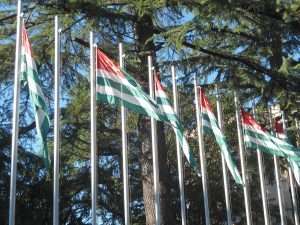
*Flags of Abkhazia waving in Sukhum (Credits: Interlaker, CC BY-SA 4.0, via Wikimedia Commons)
