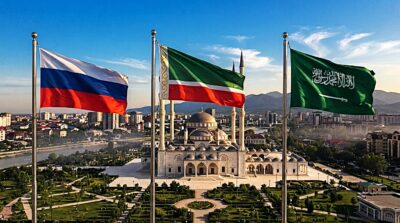
Executive Intelligence Snapshot
This report examines Saudi State Minister Turki bin Mohammed Al Saud’s official visit to Grozny and his meeting with Chechen leader Ramzan Kadyrov, highlighting Riyadh’s interest in Chechnya’s economic potential and Kadyrov’s role in facilitating Russian relations with the Gulf Arab monarchies.
The visit underscores Saudi Arabia’s continued political and economic engagement with Chechnya, particularly in promoting investment, despite the absence of reliable and up-to-date figures on bilateral trade. It also highlights Kadyrov’s increasingly prominent role in advancing Moscow’s diplomatic engagement with the Arab and Muslim world, particularly the Gulf states.
Background Information
On 14 November 2026, Saudi State Minister and member of the Council of Ministers Prince Turki bin Mohammed bin Fahd Al Saud paid an official visit to Grozny, where he met with the Chechen leader Ramzan Kadyrov and Saudi Ambassador to Russia Sami Mohammed Al-Sadhan.
The Saudi minister visited the newly developed Vladimir Putin district, where he was briefed on ongoing construction works and planned residential and service infrastructure projects. He subsequently met Kadyrov at the presidential residence, conveying greetings from King Salman bin Abdulaziz Al Saud and Crown Prince Mohammed bin Salman.
Saudi-Chechen relations have developed considerably since the early 2000s. In January 2004, former Chechen President Akhmat Kadyrov visited Saudi Arabia and held meetings with the Kingdom’s leadership, including King Fahd. Akhmat Kadyrov’s visit to Riyadh marked the beginning of a new phase in relations between Saudi Arabia and Russia, considering that, during the ‘90s, Moscow had several times accused the Saudi royal family to covertly support Islamist movements in the North Caucasus.
From 2007 onwards, Ramzan Kadyrov has increased his engagement with Gulf Arab monarchies through regular visits and direct contacts with regional leaders: in this context, Saudi Arabia has become a prominent key actor in economic cooperation from the mid-2010s.
In 2016, a Saudi delegation led by State Minister Ahmed Al-Khatib visited Chechnya, with discussions reportedly covering investment opportunities in the Akhmat Tower complex and the Veduchi mountain resort. In 2017 and 2018, Chechen authorities presented additional investment opportunities in agriculture, industry, tourism and transport. Proposed initiatives included direct air connections between Grozny and Jeddah, the development of tourism facilities and educational exchanges with Saudi universities.
Religious, educational and humanitarian cooperation has also formed part of the relationship. In 2018, delegations from the Muslim World League and the World Organisation for the Memorisation of the Holy Quran and Sunnah visited Chechnya. Discussions reportedly included cooperation between religious institutions, educational exchanges and initiatives to attract Saudi religious tourists and visitors to the republic.
In August 2026, Grozny hosted an international conference marking the centenary of diplomatic relations between Russia and Saudi Arabia, alongside the 75th anniversary of Akhmat Kadyrov’s birth. The event brought together representatives from almost 20 countries.
Why Does It Matter?
Prince Turki bin Mohammed Al Saud’s visit to Grozny confirms Riyadh’s continued interest in expanding its political and economic engagement with Chechnya.
While Chechnya’s landlocked geography limits its role as a physical transit corridor compared to Caspian coastal neighbours like Dagestan, the republic holds significant political and symbolic weight in the North Caucasus, connecting Moscow’s domestic Muslim-majority regions with the wider Middle East. Therefore, Saudi Arabia’s engagement with Grozny extends beyond bilateral regional contacts and forms part of its broader relationship with Russia.
Although Chechen authorities have pitched flagship projects, such as the Akhmat Tower complex and the Veduchi mountain resort, since 2016, actual Saudi capital inflows remain opaque and largely symbolic. Saudi sovereign wealth vehicles remain cautious of Western secondary sanctions, particularly given Kadyrov’s designation under US and European sanctions regimes. Consequently, Riyadh’s engagement in Grozny functions less as a commercial investment drive and more as a low-cost diplomatic gesture to maintain goodwill with the Kremlin alongside broader coordination within OPEC+ and St. Petersburg International Economic Forum (SPIEF) frameworks.
The visit also highlights Ramzan Kadyrov’s growing role in promoting Russian diplomacy with the Gulf Arab monarchies. Since assuming leadership of the republic, Kadyrov has undertaken several official visits to Gulf countries, while Grozny has hosted numerous diplomatic delegations from the Arab and Muslim world. Chechnya’s status as a predominantly Muslim republic within the Russian Federation provides Moscow with an additional channel for engagement with Middle Eastern governments, particularly on issues involving religious cooperation, humanitarian assistance and economic relations.
This diplomatic role is not exclusive to Chechnya. The Republic of Tatarstan has also emerged as an important platform for Russian engagement with the Islamic world, notably through the annual International Economic Forum ‘Russia – Islamic World” in Kazan. Against this background, the expansion of Saudi-Chechen relations may provide Kadyrov with an opportunity to strengthen Grozny’s position as one of Moscow’s principal interlocutors with the Arab-Muslim world. Greater engagement with Saudi Arabia and other Gulf monarchies could consequently enhance Chechnya’s diplomatic profile and its competitive position relative to other Russian Muslim-majority regions, particularly Tatarstan.
Another important dimension concerns Islamic finance. In 2023, the Russian Federation launched a pilot project to assess the implementation of Islamic banking and financial products, which the State Duma subsequently extended until September 2028. Chechnya, alongside Dagestan, Bashkortostan and Tatarstan, was selected to participate in the initiative. The programme seeks to evaluate how financial instruments compliant with Islamic principles can be integrated into the Russian financial system, particularly in regions with substantial Muslim populations.
While Tatarstan currently dominates the pilot’s registered entities and transaction volume, Saudi investment and technical expertise could support the development of this sector in the North Caucasus, especially in Chechnya, providing Riyadh with opportunities to strengthen its position in the emerging Russian Islamic finance market, a field where the United Arab Emirates has already established a significant regional and international footprint.
The development of Saudi-Chechen relations should also be considered within the broader context of Russian-Saudi strategic cooperation. Riyadh’s engagement with Grozny could complement the existing partnership between Moscow and the Kingdom, providing Russia with an additional diplomatic channel towards the Saudi leadership. This relationship is particularly relevant to cooperation in energy markets, including through OPEC+, as well as wider diplomatic engagement in international forums. Saudi Arabia’s evolving regional security environment, particularly following the escalation of the US-Israeli confrontation with Iran in February 2026 and renewed Houthi activity, has further increased the importance of maintaining diversified diplomatic partnerships and regional relationships.
For Moscow, Kadyrov’s personal relationships with Gulf leaders offer an additional instrument for promoting Russian political and economic interests. Through Chechnya, the Kremlin can facilitate diplomatic contacts, encourage investment in the North Caucasus and promote economic cooperation in sectors relevant to the region’s infrastructure and socioeconomic development. This engagement also provides an opportunity to strengthen Russia’s image and diplomatic presence among Muslim-majority countries, an increasingly relevant consideration amid the international polarisation associated with the Ukraine conflict and competing diplomatic efforts by Moscow and Kyiv to maintain relations with the wider Muslim world.
Collectively, these developments indicate that the Saudi-Chechen relationship has significance beyond the bilateral level. It represents an additional dimension of Russian-Saudi engagement, combining regional diplomacy, economic cooperation, Islamic finance and the political influence of Muslim-majority republics within the Russian Federation.
Outlook
In the short term, Saudi engagement with Chechnya is likely to continue through official visits, investment initiatives, and humanitarian, educational and religious cooperation. These activities are expected to support the broader framework of Russian-Saudi relations, while providing Riyadh with additional opportunities to strengthen its economic and political presence in the North Caucasus.
Ramzan Kadyrov is likely to maintain his role in promoting Moscow’s interests in Saudi Arabia and other Gulf monarchies through official visits, high-level meetings and the use of religious and cultural ties to facilitate diplomatic engagement. This could further strengthen his position within Russian foreign policy networks and enhance his political profile in the North Caucasus and among Russia’s Muslim communities.
However, this dynamic carries inherent friction with Moscow. Federal security services have reportedly viewed Kadyrov’s independent outreach to Middle Eastern leaders with suspicion, particularly amid persistent speculation regarding his health, the political grooming of his sons, who personally delivered a letter for Crown Prince Mohammed bin Salman during Prince Turki’s visit, and the possibility that Grozny’s Gulf diplomacy serves as a personal contingency plan for asset protection or safe haven. Moscow will therefore seek to utilize Kadyrov’s Arab-world access while curbing any autonomous foreign policy freelancing or demands for greater political autonomy.
Saudi engagement in Chechnya could also create opportunities for Riyadh to expand its presence across the wider North Caucasus, potentially extending its economic and diplomatic relations to other Muslim-majority republics in the region. Increased Saudi investment could support Moscow’s efforts to attract foreign capital for infrastructure development and local socioeconomic projects, particularly in areas where investment remains necessary to sustain regional development strategies. For the Kremlin, this would represent an opportunity to strengthen economic relations with a major Gulf partner while using existing regional diplomatic channels to facilitate cooperation.
Nevertheless, an expansion of Saudi involvement will introduce political and security considerations for Moscow, particularly in the religious sphere. Given the historical tensions surrounding foreign-funded Islamist networks in the North Caucasus during the 1990s and early 2000s, Russian federal authorities will closely monitor Saudi involvement in local religious institutions, including the construction and financing of mosques and madrasas. To prevent external ideological influence from undermining regional stability, Moscow is expected to enforce strict federal oversight over all bilateral religious and humanitarian programs.
