Executive Intelligence Snapshot
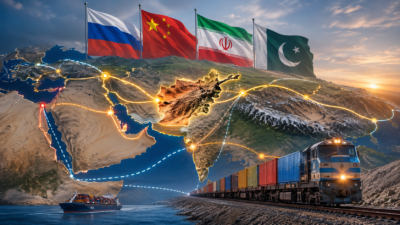
Afghanistan is regaining strategic relevance as a potential north–south transit hub, driven by Eurasian geopolitical realignments and regional efforts to diversify connectivity routes towards South Asia and the Indian Ocean.
Despite persistent security threats, infrastructure constraints and political uncertainties, China, Russia, Iran and Central Asian states increasingly view the country as a strategic component of emerging transport networks.
However, Afghanistan’s geographical potential does not guarantee operational centrality, which will depend on infrastructure development, regional cooperation and the ability to contain cross-border security risks.
Context
On 25 September 2025, the foreign ministers of China, Russia, Pakistan and Iran held their fourth quadrilateral meeting in New York. Their joint statement expressed concern over the presence in Afghanistan of the Islamic State Wilayat Khorasan (ISKP), Al-Qaeda, the Eastern Turkistan Islamic Movement (ETIM), Tehrik-e-Taliban Pakistan (TTP), Jaish al-Adl, the Balochistan Liberation Army (BLA) and other militant organisations.
On 5 October 2026, Afghanistan, China, India, Iran, Kazakhstan, Kyrgyzstan, Pakistan, Russia, Tajikistan and Uzbekistan participated in the Moscow Format, a Russian-led platform for coordinating regional approaches to the Afghan peace settlement. No joint statement was issued because the Afghan and Pakistani delegations disagreed over the wording on terrorism.
The Taliban takeover in August 2021 substantially reduced armed conflict compared with previous decades. The European Union Agency for Asylum (EUAA) documents a relative absence of armed conflict and a virtual halt in active hostilities after 2021. The Taliban’s consolidation of territorial control has also enabled regional governments to negotiate infrastructure projects with a single de facto authority across most of Afghanistan.
Nevertheless, Afghanistan retains three interconnected security vulnerabilities:
- ISKP’s transnational recruitment networks, operational presence and capacity to target foreign interests;
- The Afghanistan–Pakistan conflict, particularly deteriorating relations over the Pakistani Taliban (TTP), cross-border militancy and military operations
- The absence of an internationally recognised, comprehensive security framework.
Despite persistent domestic security concerns, Eurasia’s geopolitical reconfiguration, shaped by the conflict in Ukraine and the war in the Persian Gulf, has encouraged Central Asian states and regional powers, particularly Russia and China, to diversify southern connectivity routes and increasingly incorporate Afghanistan into emerging logistics networks.
Regional countries do not necessarily need to resolve Afghanistan’s internal security problems before using it as a transit country. Rather, they must determine whether risks can be sufficiently contained to protect specific transport corridors, border crossings and infrastructure. The main mechanisms for addressing this challenge remain the China–Russia–Iran–Pakistan quadrilateral, the Moscow Format and the Shanghai Cooperation Organisation (SCO).
Analysis
For decades, Afghanistan was viewed primarily as a geopolitical buffer zone, a security black hole or a conflict theatre. Its emergence as a focal point of Eurasian connectivity reflects structural changes in trade, geopolitical realignments and economic geography, despite persistent security threats and the Taliban administration’s lack of international recognition.
The first geopolitical trigger was the conflict in Ukraine, which abruptly cut off Russia’s main trade routes to Europe through Western sanctions, forcing Moscow to redirect its trade networks southward and eastward. Central Asian republics, particularly Uzbekistan and Kazakhstan, faced a parallel dilemma: traditional transit routes through Russia to European markets became exposed to secondary-sanctions risks and operational disruptions, increasing the need for direct access to warm-water ports.
Afghanistan offers the shortest and most direct land bridge connecting landlocked Central Asia to the Indian Ocean through Pakistan (Karachi and Gwadar) and Iran (Chabahar and Bandar Abbas). Uzbekistan and Kazakhstan are therefore seeking to overcome their geographical isolation. The flagship Trans-Afghan Railway project, connecting Tashkent through Kabul to Pakistani ports, could reduce cargo delivery times to South Asia and global markets. Routes through Afghanistan into Iran’s railway network would also bypass congested Caspian Sea connections.
For Tehran, expanding rail links such as the Khaf–Herat line and connecting Central Asia directly to Chabahar and Bandar Abbas would generate transit revenue, facilitate sanctions circumvention and anchor regional economic dependencies to Iranian infrastructure.
Moscow, meanwhile, actively supports Afghanistan’s integration into regional transit corridors as a potential branch of the INSTC. Connecting Russian railways through Central Asia and Afghanistan to the Arabian Sea could create a sanctions-resistant supply chain serving India, South Asia and the Middle East.
Moscow’s concerns also include preventing ISKP expansion into Central Asia, protecting Tajikistan and other regional partners, containing radicalisation and militant infiltration along the former Soviet Union’s southern perimeter, and maintaining Afghanistan’s integration into regional economic and transport networks.
Russia has also developed diplomatic relations and military cooperation with the Taliban authorities, combining political engagement with counterterrorism demands. Its June 2026 intervention at the UN Security Council was particularly relevant, as Moscow explicitly questioned the sufficiency of the Taliban’s counterterrorism efforts.
Beijing considers Kabul a missing link in its Belt and Road Initiative (BRI). Connecting Central Asia and Afghanistan to the China-Pakistan Economic Corridor (CPEC) would integrate western China with the Arabian Sea. Beijing also seeks long-term access to Afghanistan’s largely unexploited mineral resources, including lithium and copper, while pursuing regional stabilisation to protect its Xinjiang border.
This shift reflects a move towards non-ideological pragmatism. Rather than prioritising moral alignment with the Taliban administration, regional powers increasingly treat it as a de facto authority capable of providing security along transit corridors.
An alternative route to Iran and the Persian Gulf, onward to the Arabian Sea, passes through Turkmenistan. On paper, this offers a shorter and lower-risk land connection, and Kazakhstan and Uzbekistan already use it to access Iranian ports. However, Afghanistan’s inclusion in long-term Eurasian integration strategies reflects structural constraints involving geography, infrastructure capacity, political friction and broader geopolitical objectives.
Transit through Turkmenistan faces several infrastructure and interoperability constraints. First, railway gauge incompatibility between Central Asia’s 1,520 mm broad-gauge network and Iran’s 1,435 mm standard-gauge system requires break-of-gauge operations at the Sarakhs–Sarakhs and Akyaila–Incheh Borun crossings, involving bogie exchanges or cargo transshipment that increase handling costs and transit times.
Second, railway terminals and connecting infrastructure constrain capacity along the eastern INSTC branch. The Eurasian Development Bank estimates annual handling capacity at approximately 7–10 million tonnes for Sarakhs and 4 million tonnes for Akyaila, recommending modernisation to accommodate higher freight volumes. Further limitations affect connecting railway sections, including Iran’s single-track, non-electrified Garmsar–Incheh Borun line. Without parallel investment in terminal capacity, railway infrastructure and operational interoperability, greater reliance on this corridor could generate congestion and undermine regional transport resilience.
Administrative and regulatory bottlenecks further complicate transit through Turkmenistan. Despite its political stability and growing participation in regional connectivity initiatives, its highly state-controlled operating environment creates additional costs and uncertainty for international transport operators. Strict visa requirements for foreign truck drivers, lengthy procedures, short visa validity periods and discretionary transit permits complicate cross-border movements. Private operators also report high road-transit tariffs, while limited transparency in tariff-setting and inconsistent administrative procedures undermine cost predictability.
Although Turkmenistan remains an important north–south transit link, excessive reliance on a single transit country would expose landlocked Central Asian economies to disruptions caused by border restrictions, regulatory changes or higher transit charges.
More broadly, Western sanctions against Tehran discourage international financiers from funding projects routed exclusively through Iran. Incorporating Afghanistan therefore offers alternative transit legs that can be integrated into wider regional networks with less dependence on Iranian territory.
Afghanistan also holds an estimated $1–3 trillion in unmined mineral wealth, including copper, lithium, iron ore and rare earths. Routing infrastructure through the country would allow China and neighbouring states to connect future extraction projects directly to regional export corridors.
Routing major transit infrastructure through Afghanistan may appear counterintuitive given neighbouring Turkmenistan’s extensive lowland and desert terrain. However, this overlooks the geography of the proposed Afghan corridors. Although the Hindu Kush dominates the country’s central and north-eastern highlands, the principal northern and north-western railway alignments are designed to bypass its highest sections.
The proposed route from Uzbekistan’s Termez–Hairatan crossing towards western Afghanistan and Iran would traverse the northern provinces of Balkh, Jawzjan and Faryab before reaching Herat through Badghis. These areas consist primarily of northern plains, lower mountain foothills and elevated plateaus, rather than the high-altitude terrain of the central Hindu Kush or Pamirs. Similarly, the Khaf–Herat railway connects eastern Iran with western Afghanistan without crossing the major mountain barriers found in northern Iran. Although some sections traverse rugged, arid terrain, the alignment does not require the extensive tunnelling and bridging associated with major trans-Alborz railway projects.
Afghanistan’s topography is therefore not a prohibitive obstacle to developing northern and western transit corridors. More significant challenges concern the engineering requirements of individual sections, construction costs, financing, security and completion of missing railway links.
The main limitation to the country’s integration into Eurasian connectivity networks is that neither China nor Russia has demonstrated an intention to assume direct responsibility for its internal security. Their documented approach relies instead on diplomatic pressure, bilateral cooperation, regional mechanisms and assistance to neighbouring countries. China, Russia, Iran and the Central Asian republics are consequently pursuing political and economic engagement with the Taliban while seeking to contain security risks through bilateral and multilateral cooperation.
A key challenge for the future of southern Eurasian corridors will be to decouple regional economic connectivity from the Afghanistan–Pakistan dispute, preventing bilateral tensions from undermining broader regional integration.
Incorporating an Iranian branch would provide an alternative route independent of Pakistani cooperation, strengthening regional transport resilience in the event of a prolonged US military campaign against Iran or renewed armed clashes between Afghanistan and Pakistan.
Outlook
The Taliban’s consolidation of territorial control since 2021 has reduced active battlefield conflicts, creating a comparatively more favourable environment for regional infrastructure and connectivity projects. Despite persistent terrorism, cross-border tensions and structural economic constraints, Afghanistan has regained strategic relevance as a potential north–south transit hub.
Shifting from a major conflict theatre towards a prospective economic bridge between Central and South Asia, Afghanistan is re-emerging as an important link in the developing greater Eurasian connectivity architecture. It offers a direct land bridge to South Asia, an alternative to reliance on Turkmenistan for transit, and access to critical mineral resources.
Nevertheless, Kabul’s role should not be overstated. Greater Eurasian integration does not revolve around Afghanistan: the Eurasian Economic Union, BRI, INSTC and Caspian transport networks retain their own geographical and institutional structures. Geographical potential does not equate to operational centrality.
