Executive Intelligence Snapshot
The CSTO joint exercises Indestructible Brotherhood-2026 and Barrier-2026 in Belarus demonstrate active operational coordination and biological threat readiness among five participating member states, while projecting strategic resolve toward Western observers.
However, Armenia’s continued boycott underscores persistent political divisions that undermine the organization’s overall institutional cohesion.
Information Context
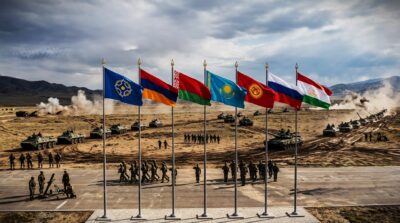
On 11 October 2026, Belarus hosted the opening ceremony of two joint exercises conducted under the framework of the Collective Security Treaty Organisation (CSTO): Indestructible Brotherhood-2026, a command-and-staff exercise involving the CSTO Collective Peacekeeping Forces, and Barrier-2026, a specialised exercise focused on chemical, biological, radiological and nuclear (CBRN) protection and medical support. The exercises involve military and security personnel from five CSTO member states: Belarus, Kazakhstan, Kyrgyzstan, Russia and Tajikistan.
According to the reported figures, the exercises involve more than 1,500 military personnel, over 300 items of military and special equipment, and approximately 80 unmanned aerial vehicles (UAVs). The opening ceremony took place at Victory Square in Vitebsk, Belarus. The practical activities are being conducted at the Losvido training centre, where peacekeeping operations are rehearsed, and the Starodorozhsky training ground, where participating personnel practise the elimination of biological threats within the area of responsibility of the CSTO Collective Peacekeeping Forces. The Russian contingent consists primarily of units from the Combined Arms Army of the Central Military District.
The stated objectives of Indestructible Brotherhood-2026 are to improve the preparation, command and execution of multinational peacekeeping operations under complex conditions. In parallel, Barrier-2026 aims to strengthen coordination between CBRN protection and medical support capabilities in response to biological threats. The exercises also involve operational representatives from the CSTO Joint Staff and Secretariat, alongside personnel from military contingents, police and other national security structures.
CSTO and Belarusian officials have presented the exercises as part of the organisation’s annual joint training programme and as a means of strengthening interoperability, maintaining the readiness of collective forces and improving coordination among participating states. Their stated rationale reflects concerns about the deteriorating regional military-political environment and the need to maintain effective collective security mechanisms. These declarations establish the official rationale for the exercises but do not, in themselves, determine their wider geopolitical purpose or demonstrate preparedness for a specific external contingency.
Analysis
The CSTO exercises Indestructible Brotherhood-2026 and Barrier-2026 demonstrate the organisation’s continued efforts to maintain collective peacekeeping readiness and strengthen coordination among participating member states, including in response to biological threats. Beyond their operational objectives, the exercises serve a political and communicative function by demonstrating continued cooperation among Belarus, Kazakhstan, Kyrgyzstan, Russia and Tajikistan within the Moscow-led security framework.
Armenia’s non-participation, against the background of its wider disengagement from the CSTO, highlights the limits of this collective cohesion. Yerevan’s decision not to resume active participation reflects persistent dissatisfaction with the organisation’s response to Armenia’s security concerns and its efforts to diversify its security partnerships.
Within the broader regional security environment, the exercises can also be interpreted as a form of strategic signalling by Moscow and Minsk towards Western countries. Their multinational composition and reported scale provide a visible demonstration of continued military cooperation and an effort to project readiness and resolve amid the Ukraine conflict and tensions between Russia and Western states. However, although such signalling may have a wider deterrent effect, the available evidence does not establish NATO as the specific intended audience. The CSTO Joint Staff has publicly stated that the exercises are not directed against third countries, identifying interoperability and the maintenance of operational readiness as their principal objectives.
Overall, the exercises are best understood as serving three complementary purposes: sustaining practical military coordination, reaffirming political engagement among participating members, and communicating collective readiness within an increasingly tense regional security environment. Armenia’s continued disengagement nevertheless demonstrates that this cooperation does not equate to full institutional cohesion across the CSTO.
Conclusion
The CSTO exercises Indestructible Brotherhood-2026 and Barrier-2026 reflect the Moscow-led organisation’s continued efforts to maintain military coordination, collective peacekeeping readiness and joint capabilities in response to regional security challenges. Beyond their operational objectives, the exercises serve a political and communicative function by demonstrating continued cooperation among participating states and reinforcing Russia’s role within the CSTO framework.
Armenia’s continued disengagement represents a significant limitation to this demonstration of cohesion. Yerevan’s efforts to diversify its foreign and defence partnerships, including through greater engagement with European and US counterparts, reflect the deterioration of its relationship with Moscow and the CSTO.
In the wider geopolitical context, the exercises may also allow Russia and Belarus to demonstrate military resolve and communicate collective readiness to Western countries, including NATO members.
Ultimately, the drills illustrate both the continued utility of the CSTO as a framework for military cooperation and the political divisions that constrain its collective security role.
