Executive Intelligence Snapshot
The upcoming International Forum “The North Caucasus: A Space of Dialogue, Traditions and Development” is a high-visibility public-diplomacy event which allows Moscow to showcase engagement with Global South partners and to present the North Caucasus as stable and open to foreign partners.
The event, which will gather international participants from Africa and Asia, will very likely yield signalling value for domestic and international audiences, but it will likely produce few substantive economic or strategic outcomes.
Information Background
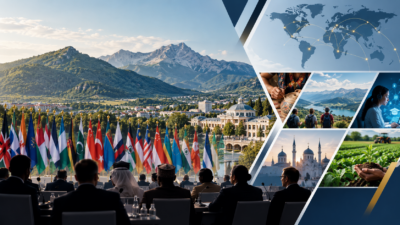
On 2-3 October 2026, the North Caucasus Institute of RANEPA and Pyatigorsk State University will host the ninth edition of an international forum “The North Caucasus: A Space of Dialogue, Traditions and Development” in Pyatigorsk and Zheleznovodsk (Stavropol Krai), with organisers claiming participation from more than 20 countries. The announced guests include the ambassadors of Kenya, Rwanda, Mozambique, Sierra Leone, Libya and Afghanistan, alongside diplomatic and expert representatives from India, Malaysia, Singapore, Türkiye, Iran, Iraq, Kyrgyzstan and Uzbekistan. The agenda centres on the creative economy, tourism, digitalization of education, interfaith dialogue and agricultural cooperation.
The forum has been held annually since 2017 and is organized by RANEPA’s North Caucasus Institute and Pyatigorsk State University, with regional support. Its stated purpose is to promote international and interregional cooperation, humanitarian ties, and intercultural and interfaith dialogue, and to present the North Caucasus as a space of open interaction and sustainable development. The organisers and participants will dedicate particular attention to the preservation of the region’s historical and cultural heritage as a resource for the creative economy. The Kenyan ambassador identified agriculture as an obvious area of practical cooperation, noting the potential for technology transfer and the exchange of best practice in addition to trade.
Analysis
The forum serves three overlapping objectives:
- The event projects Russian foreign policy toward the Global South and encourages economic relations and cooperation.
- It supports the role of the North Caucasus in Russian foreign and economic policy, acting as a platform for regional paradiplomacy in which the North Caucasian republics seek trade and investment ties with foreign countries.
- It functions as strategic communication, offering a positive narrative of Russian international cooperation to counter the perception of isolation resulting from the Western sanctions imposed since the start of the Ukraine conflict in 2022. The choice of the North Caucasus over Moscow or St. Petersburg also carries a security dimension, since presenting the region as a space of dialogue implicitly counters its reputation for insurgency, political violence and centre-periphery tension.
The forum’s principal value lies in signalling rather than substance. The presence of ambassadors generates imagery and statements that Moscow can use, domestically and abroad, as evidence that sanctions have not produced diplomatic isolation. The announced programme includes no memoranda of understanding, named investors or ministerial-level participation, and most named attendees are diplomats already accredited in Moscow, which is a low-cost, low-commitment form of participation.
The guest list reflects a recalibration of Russian foreign policy toward Africa, the Middle East, Central and South Asia and Southeast Asia, and indicates where Moscow may focus its diplomatic and commercial effort in the short term. The replacement of European trade since 2022 has been driven mainly by China, India and Turkey, not by the African states named here. The attendance of African representatives is consistent with Moscow’s continued interest in the continent, which Russian institutional thinking, including an editorial of the SVR journal Razvedchik describing Africa as an arena of international competition affected by the “neocolonialism”, treats as a contested space. Attendance from the post-Soviet space and the Middle East signals that Moscow remains active in areas it regards as strategic.
The participants should be read as a differentiated set of partners rather than a bloc. The Afghan presence is the most politically sensitive, given Russia’s recent normalisation of relations with the Taliban authorities since July 2025 when Moscow officially recognised the Islamic Emirate of Afghanistan.
The Libyan case is similar, since Russian interests are concentrated in the east of the country and the authority represented is analytically important. Kenya, designated a Major Non-NATO Ally of the United States in 2024, is best understood as hedging and pursuing pragmatic agricultural interests rather than aligning with Moscow. India, Turkey, Malaysia and Singapore maintain balanced relations with all major powers and are partners of convenience. Kyrgyzstan, Uzbekistan, Iran and Iraq reflect continuity of engagement in regions where Moscow seeks to remain influential.
At the sub-national level, the forum offers North Caucasian republics a platform to seek partnerships in agriculture, tourism and education. Such outcomes are more plausible at the sectoral and regional level than at the strategic level, since no local and international sources reported the eventuality that the parties involved in the event might sign memoranda of understanding.
Conclusion
The forum will reinforce the Kremlin’s narrative at the domestic and international levels even though it might generate limited regional economic initiatives between North Caucasian republics and foreign partners. Instead of significantly alter the wider Eurasian strategic balance, the forum provides a signal of Moscow’s foreign-policy and economic orientation toward the Global South.
Over the next 6-12 months, policymakers and investors must monitor the region and Moscow’s local and regional strategy regarding these indicators:
- Possible agreements and memoranda of understanding between North Caucasian entities and foreign partners that might confirm the Russian economic strategy and Moscow’s exploitation of the North Caucasus for its foreign policy;
- Official visits and delegation from the participant countries that might formalise their engagement in the North Caucasus;
- Trade and investment data between the North Caucasian republics and those countries;
- The seniority and numbers of participants at the next edition of the forum, where growth would indicate rising substance and continued reliance on accredited ambassadors would indicate a symbolic function.
