Executive Intelligence Snapshot
The 2026 Eastern Economic Forum (EEF) highlighted that Moscow continues to treat the Russian Far East as a strategic platform for economic adaptation, deeper engagement with Asia-Pacific partners and the development of alternative trade and financial channels outside Western-controlled systems.
During the forum, by highlighting foreign participation, investment agreements and expanding connectivity with Asian economies, Moscow seeks to demonstrate that Western sanctions have not isolated Russia, while positioning the Far East as an emerging economic and geopolitical hub with implications for both Chinese and US interests in the Asia-Pacific.
Key Takeaways
- The EEF provides Moscow with a mechanism to institutionalise its economic pivot towards Asia by linking Russian resources, infrastructure and industrial capacity to Asian markets, investment and transport networks.
- The participation of more than 9,300 people from 78 countries, including representatives from 18 states classified by Russia as “unfriendly”, provides Moscow with evidence to support its narrative that Russia retains significant international economic engagement despite Western sanctions.
- The expansion of non-Western payment arrangements, including Russian banking services in Southeast Asia, indicates an effort to reduce exposure to Western financial infrastructure and establish alternative mechanisms for cross-border trade.
- The concentration of investment in mining, hydrocarbons, petrochemicals, transport, semiconductors and scientific infrastructure indicates that the Far East is being developed not solely as a resource base, but as a longer-term strategic economic platform for Russia’s engagement with the Asia-Pacific.
Information Context
The Eastern Economic Forum (EEF) was established by presidential decree in May 2015 with the stated purpose of supporting the economic development of Russia’s Far East and expanding international cooperation in the Asia-Pacific region. The inaugural forum was held in Vladivostok in September 2015, and the event has subsequently become a principal Russian mechanism for presenting investment opportunities in the Far East and facilitating contacts between Russian authorities, businesses and foreign investors.
The 11th EEF was held in Vladivostok from 1–4 September 2026 under the theme “The Far East: Development for the Benefit of People”. The programme covered international cooperation, technological development, investment, quality of life, logistics and infrastructure. Russian authorities stated that more than 7,000 participants from 78 countries attended the event, while final reporting put overall attendance above 9,300, including more than 1,200 media representatives and participants from 18 states designated by Moscow as “unfriendly”. The largest foreign delegations included China, Indonesia, Japan, Vietnam, South Korea, India and Myanmar.
President Vladimir Putin appeared alongside Indonesian President Prabowo Subianto, Mongolian Prime Minister Nyam-Osoryn Uchral, Myanmar Vice-President Nyo Saw and Chinese Vice-Premier Ding Xuexiang. The participation of high-level political figure from foreign countries reinforced Moscow’s narrative towards the EEF as a forum connecting Russia with major Asian economies and neighbouring states rather than as a predominantly Russian domestic economic event.
Russian officials consistently presented the forum as part of a wider strategy to integrate the Far East into the Asia-Pacific economic system. Putin described the region as a platform for cooperation in logistics, industry, energy, technology, infrastructure and human capital, while Russian officials emphasised that Far Eastern economic and investment indicators were exceeding national averages. The Kremlin has also linked the region’s development to a broader strategy aimed at creating a more diversified, technologically advanced economy and improving demographic conditions.
Russian officials reported 318 agreements worth almost RUB 7 trillion, excluding documents classified as commercial secrets. Major areas of investment included extraction and processing of hydrocarbons and minerals, petrochemicals, transport infrastructure, scientific facilities and advanced manufacturing.
Among the projects highlighted in the source are a RUB 100 billion petrochemical cluster spanning Amur Oblast, Primorsky Krai and Khabarovsk Krai; more than RUB 80 billion for copper extraction and processing in Magadan Oblast; RUB 75 billion for a tungsten-copper mining and metallurgical complex in Yakutia; approximately RUB 70 billion for a mining and processing facility in Chukotka; and RUB 75 billion for the proposed Muravyov-Amursky Pacific Scientific and Technological Valley near Vladivostok. Additional projects involve gold, semiconductors, heavy vehicles and transport infrastructure.
Financial connectivity was another significant element. VTB announced the extension of QR-code payment services to Indonesia and the Philippines, with plans to expand the service to Malaysia, Singapore and Myanmar. Russia is simultaneously deepening economic and technological cooperation with Iran, including nuclear energy cooperation at Bushehr. These measures indicate an attempt to build practical channels for trade and settlement that are less dependent on Western financial infrastructure.
During the forum, the parties discussed transport projects due to their strategic significance such as the Trans-Arctic Transport Corridor, the modernisation of the Trans-Mongolian railway linking Russia with Mongolia and northern China, and proposed routes connecting Siberia and the Russian Far East with Mongolia and China’s Xinjiang region.
Why Does It Matter?
The primary significance of the EEF lies in the convergence of economic development, sanctions adaptation and foreign policy.
Moscow is not simply attempting to attract capital into an underdeveloped region since the Far East provides Russia with a geographical platform from which it can redirect trade towards Asian markets. This is particularly important following the deterioration of Russia’s economic relations with Europe because of the Ukraine conflict and Western sanctions against Moscow. Infrastructure connecting eastern Russia with China, Mongolia and the wider Asia-Pacific region can provide alternative outlets for Russian commodities and potentially reduce the strategic impact of Western restrictions.
The EEF therefore forms part of a broader Russian strategy of economic diversification under geopolitical pressure. The emphasis on payment mechanisms is particularly relevant: indeed, even though the establishment of a completely separate international banking system remains unproven, the gradual expansion of non-Western settlement mechanisms could reduce the effectiveness of sanctions over time by creating alternative financial channels and increasing the number of states capable of conducting transactions with Russia outside Western-controlled systems.
Looking at the official statements and the media coverage, it is possible to underline that the forum also provides Moscow with an important political signalling mechanism. Russian authorities have used the presence of Asian governments, businesses and investors to demonstrate that Russia retains international partners despite sanctions and, therefore, counter the Western narrative of “isolation”. The participation of representatives from states that Moscow itself categorises as “unfriendly” is particularly useful for this narrative. However, participation should not be interpreted automatically as political alignment since different Asian states have strong incentives to diversify their economic relationships while maintaining relations with the United States and China.
China occupies a particularly important position in this strategy. Beijing provides Moscow with access to a major market, capital, logistics networks and industrial capacity, while Russia supplies China with energy and raw materials and offers access to Arctic and continental transport routes. Chinese officials have publicly described the prospects for cooperation in developing the Russian Far East as extensive, reinforcing the importance of the region in bilateral relations.
This creates a strategic dilemma for Moscow. Russia requires Chinese economic participation to strengthen its Asian pivot, but excessive dependence on China could replace one form of external economic dependence with another. The development of the Far East can therefore be understood partly as an attempt to increase Russia’s bargaining power within its relationship with China, rather than simply as an anti-Chinese strategy.
For the United States, the development of these networks matters because they could contribute to a more fragmented Asia-Pacific economic environment in which US financial and technological influence is less dominant. The EEF does not by itself demonstrate the emergence of a coherent Russia-led alternative economic bloc, but it indicates that Moscow is attempting to exploit the growing economic weight of Asia and the willingness of regional states to pursue strategic diversification.
The same process has implications for China. Beijing benefits from greater Russian connectivity with Asia and from access to Moscow’s energy and resources, but a successful Russian Far East could also strengthen Moscow’s economic autonomy and bargaining position. China therefore has an interest in participating in the region’s development while retaining substantial influence over its emerging economic architecture.
The principal caveat is that announced agreements should not be equated with realised investment. The headline value of nearly RUB 7 trillion demonstrates the scale of commitments presented at the forum, but implementation, financing, construction and commercial viability will determine whether these agreements generate durable changes in Russia’s economic position. The distinction is particularly important for capital-intensive mining and transport projects.
Conclusion
Over the next 6–18 months, Russia is likely to continue using the EEF framework as well as official visits and bilateral relations with neighbouring countries in the East to institutionalise its economic and diplomatic pivot towards Asia. Moscow will probably prioritise agreements that increase trade with China and Southeast Asia, expand alternative payment mechanisms and strengthen transport links capable of moving Russian commodities towards Asian markets.
- Most likely scenario – Incremental Asian integration: Russia continues expanding bilateral economic arrangements with China, India, Southeast Asian states, Iran and other non-Western partners while presenting this activity as evidence that sanctions have failed to isolate the Russian economy. Progress is likely to be uneven, with commercial interests driving cooperation more strongly than political alignment.
- Alternative scenario – China-centred Asian pivot: Moscow increasingly uses Chinese infrastructure, financial institutions and logistics networks as an intermediary for wider access to Asia-Pacific markets. This would accelerate Russia’s reorientation away from Europe but increase Russian dependence on Beijing and potentially reduce Moscow’s strategic autonomy.
- Higher-impact scenario – Far East consolidation: A significant proportion of the investment agreements announced at the EEF progresses into construction and production. Expansion of mining, petrochemical, semiconductor, transport and scientific projects could strengthen the Far East as a durable economic centre and provide Russia with greater capacity to sustain trade with Asia under continued Western pressure.
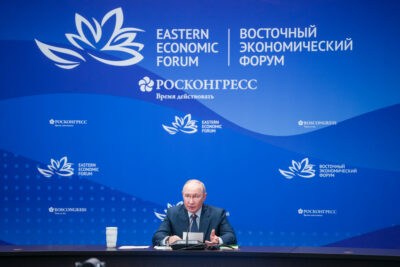
*Cover image: Russian President Vladimir Putin’s speech during the Eastern Economic Forum (Credits: Roscongress)
