Executive Intelligence Summary
Iran’s reliance on the UAE dirham as an intermediary currency creates a structural vulnerability that external actors can exploit to disrupt payments, restrict foreign-currency liquidity and intensify pressure on the rial.
Previous US–UAE operations against Iranian financial networks, reported restrictions on dirham accounts, and Washington’s declared strategy of creating a dollar shortage provide grounds to assess the potential weaponisation of this interdependence.
In this context, this report, additionally investigates the possibility that Emirati financial measures contributed deliberately to the economic conditions causing the January 2026 protests in Iran. The allegation is consistent with documented precedents and a wider convergence of strategic interests between Abu Dhabi, Washington and, increasingly, Israel.
Information Background
The UAE, particularly Dubai, has long served as a financial and commercial intermediary for Iranian businesses seeking access to foreign currencies and international suppliers. Iranian economist Majid Shakeri estimates that the dirham is involved in approximately 85% of relevant settlement processes and accounts for 45–50% of final import payments. These attributed figures have different denominators and are not independently audited, but they suggest that the currency’s importance extends well beyond bilateral trade.
There are precedents for financial pressure against Iranian networks operating through the UAE. In May 2018, Washington publicly documented joint US–UAE action against an Iranian currency-exchange network transferring US-dollar banknotes to Iran. Iranian former Economy Minister Seyed Ehsan Khandouzi subsequently cited restrictions on dirham accounts, arrests of currency dealers in 2019 and the detention of an Iranian banking official responsible for foreign-exchange settlement.
In February 2026, US Treasury Secretary Scott Bessent stated that Washington had created a dollar shortage in Iran, linking financial pressure to a major bank’s failure, monetary expansion, rial depreciation and inflation. Bessent claimed that Washington engineered the dollar shortage in Iran to send the rial into freefall and cause protests on the streets.
Separately, an Iranian diplomatic source told SpecialEurasia that the UAE had deliberately contributed to the rial’s collapse before the January 2026 protests, allegedly in coordination with the United States.
Again, after on 19 August 2026, the United States announced the Operation Economic Outcast, the UAE announced the suspension of trade, commercial exchanges and financial transactions with Iran until further notice, which led to the further depreciation of the rial.
Analysis
Dirhamisation: mechanisms and structural vulnerabilities
Dirhamisation refers to the use of the UAE dirham (AED) as an intermediary currency, liquidity reserve and settlement instrument within Iran’s foreign-exchange and trade-payment networks. It does not mean that Tehran has adopted the dirham as legal tender or that all Iranian foreign trade is conducted in AED.
The system developed partly in response to sanctions, restricted access to correspondent banking and the limited international convertibility of the Iranian rial. UAE-based exchange houses, intermediary companies and offshore accounts enable Iranian economic actors to convert currencies, transfer funds and settle payments with overseas suppliers. Consequently, the dirham may facilitate transactions involving third countries, including China, even when the goods do not originate in the UAE.
The vulnerability has three interconnected dimensions:
- Settlement dependence makes Iranian importers reliant on dirham liquidity to complete transactions.
- Conversion dependence allows the currency to bridge the rial, revenues received in other currencies and the foreign exchange required for final payments.
- Jurisdictional dependence exposes accounts, exchange houses and intermediaries operating in the UAE to Emirati regulation and enforcement, including measures associated with US sanctions and financial-compliance requirements.
Reported conversion chains illustrate the system’s complexity.
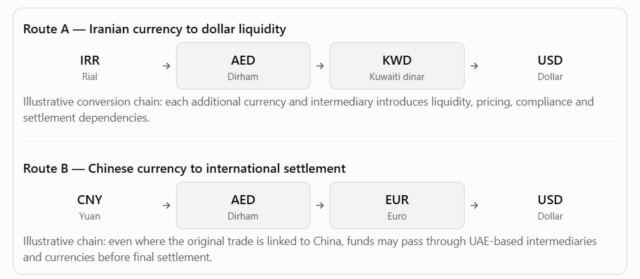
These are illustrative routes rather than universal transaction sequences. Their significance is that even trade initially connected to China or another third country may depend on UAE-based intermediaries and access to particular currency pools before payment reaches the final supplier.
This financial architecture also creates an information vulnerability. Accounts, exchange houses and front companies generate data on transaction volumes, counterparts, and settlement patterns.
Khandouzi has argued that the UAE became a focal point for information on Iranian financial and commercial activity through front companies, Iranian exchange houses and branches of Bank Melli and Bank Saderat. He also referred to Gulf financial information-sharing with Washington. Nevertheless, the extent of access to particular accounts and datasets depends on the relevant arrangements; not every transaction should be assumed to be automatically visible to US authorities.
The dirham’s peg to the US dollar reinforces the vulnerability, although it does not mean Washington controls every dirham transaction. The risk arises from the combination of concentrated settlement activity, Emirati jurisdiction and the exposure of UAE-based institutions to US sanctions and compliance pressure. Restrictions on accounts, transfers or liquidity providers can reduce currency availability, increase conversion costs, delay import payments and force traders towards more expensive alternatives. If foreign-currency supply falls while demand remains high, the rial may depreciate, increasing import costs and inflationary pressure.
The system is not immune to substitution. Iranian actors can seek direct yuan settlement, Russian financial channels, barter arrangements or commercial routes through Oman and Turkey. However, alternative transport corridors do not automatically provide alternative payment infrastructure.
Diversification requires reliable counterparties, available liquidity and functioning settlement mechanisms. Iran’s domestic foreign-exchange arrangements have also reinforced established practices: incentives created by its multiple exchange rates can encourage traders to retain familiar intermediaries. The central vulnerability is therefore not simply dependence on one currency, but concentration within a financial network whose critical nodes fall under a foreign jurisdiction.
UAE financial leverage, US coordination and the January 2026 protests
The allegation that Emirati financial measures contributed deliberately to the January 2026 currency crisis must be assessed against the history of US–UAE cooperation and the two countries’ broader strategic alignment.
A relevant recent precedent is the joint US–UAE operation publicly documented in May 2018 against an Iranian currency-exchange network transferring dollar cash to Iran, but there also have been previous instances.
Reported restrictions on Iranian dirham accounts following the US withdrawal from the Joint Comprehensive Plan of Action (JCPOA), together with the arrests of currency dealers and the detention of a banking official in 2019, further illustrate how financial pressure can target accounts, intermediaries and the personnel managing settlement flows.
These episodes establish an operational precedent for bilateral cooperation against Iranian financial networks, which aligns with the geopolitical relationship between Abu Dhabi and Washington, the latter having designated the UAE as a “Major Security Partner” in 2021.
A second element is Washington’s declared economic strategy. In February 2026, Bessent publicly described the creation of a dollar shortage in Iran to cause financial instability and street protests. His remarks provide evidence that the US administration regarded restrictions on dollar access as an instrument of economic, and, therefore, social pressure.
The allegation reported by the Iranian diplomatic source is therefore analytically significant (although it could be part of Tehran’s narrative or communication strategy). If Emirati restrictions reduced access to a major settlement channel while Washington pursued a strategy of limiting dollar liquidity, the combined effect could have aggravated foreign-currency scarcity, weakened the rial and intensified pressure on purchasing power. The convergence between the source’s account, the documented history of US–UAE financial cooperation, and Bessent’s subsequent statement makes the hypothesis plausible enough to warrant further investigation.
This possibility acquires greater geopolitical significance when placed within the wider history of Emirati and Saudi opposition to the JCPOA. Between 2015 and 2018, both governments lobbied in Washington against the agreement.
UAE Ambassador Yousef al-Otaiba was a prominent participant in efforts to persuade the Trump administration to adopt a harder line towards Tehran. The European Council on Foreign Relations has assessed that this lobbying contributed to Trump’s hostility towards the agreement before the US withdrawal in May 2018. Abu Dhabi and Riyadh subsequently supported the withdrawal and the reimposition of sanctions. Neither government alone determined Washington’s decision, but their actions demonstrate a sustained convergence of interests around constraining Iran’s economic and regional influence.
The UAE’s growing relationship with Israel adds another strategic dimension. The normalisation of relations under the 2020 Abraham Accords and the subsequent expansion of bilateral cooperation have brought Abu Dhabi closer to a state that regards Iran as a major regional adversary.
This alignment does not necessarily prove that Emirati financial measures against the Islamic Republic are coordinated with Israel. It does, however, raise questions about the strategic implications of Iran’s dependence on a financial intermediary whose regional partnerships increasingly overlap with those of its principal adversaries.
The UAE’s August 2026 suspension of financial and commercial transactions with Iran further illustrates the potential scale of this leverage. Iraqi political commentator Omar Abdulsattar Mahmoud reported that the rial weakened from IRR 1.905 million to IRR 2 million per US dollar over three days following the announcement (while also sustaining the theory of an Emirati involvement in the rial crisis that caused the January 2026 protests). This represents an approximately 5% increase in the rial-per-dollar exchange rate, although the movement alone cannot isolate the impact of the Emirati decision from other economic and political factors.
Nevertheless, the UAE might have sometimes prioritised pragmatic off-the-record negotiations to safeguard critical infrastructure over alignment with its allies. According to some unconfirmed allegations, at the beginning of August 2026, the Emirates transferred gold to Iran to avoid further attacks on their soil. Other sources pointed to a shadow diplomacy led by Sheikh Tahnoun bin Zayed Al Nahyan, National Security Advisor of the UAE and a pivotal figure in Abu Dhabi’s financial apparatus.
Abu Dhabi’s policy likely occupies a middle ground between these two positions. While the central government aims to curb Iranian regional hegemony, more pragmatic domestic power centres are inclined to pursue business opportunities through a pragmatic, non-ideological approach.
Conclusions
The dirhamisation phenomenon creates a structural vulnerability by concentrating foreign-trade settlement, currency conversion and financial intermediation within a network exposed to Emirati jurisdiction and potential US sanctions cooperation. The 2018 US–UAE operation establishes a precedent for bilateral action against Iranian currency networks, while Washington’s declared dollar-shortage strategy provides further context for assessing the January 2026 allegations.
The claim that Emirati measures deliberately contributed to the conditions preceding the protests remains unverified, but the available information provides a substantive basis for investigating it. The UAE’s historical lobbying against the JCPOA, its alignment with US maximum-pressure policies and its increasingly close relationship with Israel reinforce the strategic importance of this Iranian financial vulnerability.
For Tehran, reducing dependence on the dirham requires more than redirecting trade towards China, Russia or other partners. It requires resilient alternative payment arrangements, diversified sources of liquidity and a domestic foreign-exchange framework that does not continually reproduce dependence on established intermediaries.
Control over financial intermediation can become an instrument of geopolitical pressure, allowing external actors to disrupt economic activity without imposing a comprehensive blockade.
