Executive Intelligence Snapshot
The Tehran Talks between Iran and a trilateral delegation from Saudi Arabia, Turkey and Pakistan represent an initial test of the proposed Mecca Defence Pact, reflecting a convergence of regional interests in containing the consequences of the Israeli–US offensive against Iran.
While Riyadh seeks to reduce security exposure and maintain internal stability, Ankara aims to expand its diplomatic influence and Islamabad seeks to balance competing commitments, the initiative could gradually reshape regional security dynamics without eliminating existing rivalries or external partnerships.
Information Background
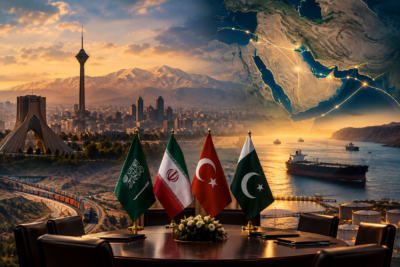
On 26 October 2026, senior officials from Iran, Saudi Arabia, Pakistan and Turkey held a quadripartite meeting in Tehran to address the Persian Gulf crisis. The meeting brought together Mohsen Rezaei, secretary of Iran’s Supreme National Security Council; Saudi Defence Minister Khalid bin Salman; Pakistani Army Chief Field Marshal Asim Munir; and Ibrahim Kalin, head of Turkey’s National Intelligence Organisation.
The Saudi–Iranian rapprochement builds on the restoration of diplomatic relations brokered by China in 2023, when Riyadh sought to reduce regional threats and protect its economic transformation agenda. Despite their persistent rivalry in Syria and Yemen, Saudi Arabia and Iran now share an incentive to prevent further escalation.
Riyadh’s continued reluctance to normalise relations with Israel without progress on the Palestinian question further distinguishes its approach from that of other GCC countries such as the United Arab Emirates (UAE), which established diplomatic relations with Tel Aviv through the Abraham Accords in 2020. The reported Israeli Iron Dome deployment in the UAE in 2026 illustrates the potential military dimension of this partnership.
Turkey and Pakistan bring different but complementary interests to the initiative. Ankara seeks to prevent Iranian destabilisation, cross-border insecurity and disruption to commercial corridors while opposing both Iranian regional predominance and an externally imposed political transformation in Tehran.
Islamabad, meanwhile, must manage its longstanding defence relationship with Riyadh alongside its shared border with Iran, cross-border security challenges and strategic competition with India, particularly over regional connectivity.
Both countries also have significant relationships with China, whose economic interests and diplomatic engagement provide incentives for regional stability, although Beijing’s support should not be equated with a security guarantee.
Analysis
The proposed pact reflects an emerging preference for regional risk management rather than a cohesive strategic alliance.
Saudi Arabia’s priority is to secure its territory, energy infrastructure and economic transformation agenda without abandoning its rivalry with Iran. If diplomatic engagement produces tangible security benefits, Riyadh could strengthen its position as a regional interlocutor and demonstrate that de-escalation can complement, rather than replace, conventional deterrence.
For Turkey, the initiative offers an opportunity to expand its influence in the Persian Gulf and prevent a prolonged conflict from strengthening Israel’s regional position or generating instability along its borders.
Ankara’s participation does not indicate alignment with Tehran: competition over Syria, the Caucasus and the wider Islamic world remains a structural feature of their relationship. Pakistan similarly has incentives to facilitate dialogue while preserving its defence ties with Saudi Arabia and its wider partnerships with Washington and Beijing. Chinese economic and diplomatic involvement may support this process, but the participants retain distinct national interests.
A successful Saudi–Iranian rapprochement could create a strategic dilemma for the UAE. If the emerging framework reduces attacks and improves the security of energy infrastructure and maritime routes, Abu Dhabi could face greater pressure to engage with a regional mechanism in which Riyadh holds a central position.
Nevertheless, diplomatic marginalisation would not equate to strategic decline: the UAE’s financial resources, logistical networks, energy capacity and partnership with Israel, alongside Abu Dhabi’s grip on the Iranian economy, would preserve substantial independent influence. Its likely challenge would be to reconcile these assets with the risk of reduced participation in regional crisis-management decisions.
The initiative’s principal vulnerability is the absence, at this stage, of demonstrated common defence commitments or an agreed mechanism for managing escalation. The participants may converge on infrastructure protection and de-escalation while disagreeing over Iran’s regional role, Israeli military operations and the future balance of power. Consequently, the pact’s significance will depend on whether political dialogue develops into practical cooperation, rather than on the symbolism of the Tehran meeting alone.
Strategic would be the potential transformation of geographical centrality into bargaining power. Saudi Arabia, Iran, Turkey and Pakistan occupy strategically significant positions along Eurasia’s energy, commercial and overland corridors. Coordination among them could increase the strategic costs of any escalation that disrupts these connections, while enhancing their ability to shape the conditions for regional stability. However, geographical convergence does not automatically translate into strategic integration; this would require concrete agreements and a sufficient degree of alignment between their respective interests.
The stability of Mohammed bin Salman’s rule may constitute an additional factor shaping Riyadh’s regional security calculations. His centralisation of power, the weakening of traditional relationships with the royal family (particularly following the 2017 palace coup), the religious establishment (the Wahhabi–Saudi pact endured for over 250 years, underpinning the religious legitimacy of Saudi rule in the Arabian Peninsula prior to MBS’s modernisation programme), and tribal leaders (following executions and forced displacement linked to the construction of megaprojects) have reportedly increased internal vulnerabilities. These developments, alongside the erosion of the social contract through economic reforms, including the privatisation of healthcare and education, may further undermine the regime’s domestic foundations.
Renewed hostilities with the Houthi, combined with threats to critical energy infrastructure and constraints on oil revenues, could further undermine the Kingdom’s security posture, economic transformation agenda and social contract. Although widespread popular unrest remains difficult to anticipate, a palace coup cannot be entirely discounted as a potential source of political instability.
In this context, security cooperation with Turkey, Pakistan and other partners may serve not only to contain regional threats but also to protect Saudi Arabia’s internal stability. External military and intelligence assistance could therefore have a dual purpose: deterring regional adversaries while helping to preserve the existing Saudi leadership against the cumulative effects of domestic and external pressures. For Riyadh’s partners, preventing a crisis at the centre of the Saudi state would also help protect energy exports, regional security arrangements and their own strategic interests in the Gulf.
Conclusion
The Mecca Defence Pact could mark the beginning of a more autonomous and pluralistic regional security environment, but its immediate significance lies in the changing calculations of individual states rather than the emergence of a unified bloc.
If Riyadh can obtain measurable security benefits through engagement with Tehran, it may strengthen its regional leadership and increase the incentive for other Gulf states to reconsider their strategic positioning, without necessarily severing existing partnerships with Washington or Israel.
The decisive variable is whether regional cooperation changes the cost-benefit calculation of escalation. A framework capable of protecting critical infrastructure, sustaining crisis communication and containing cross-border threats could gradually reduce dependence on external security guarantees; without such capabilities, the initiative is likely to remain a diplomatic instrument constrained by competing national interests.
The principal indicator to monitor is therefore not the formal consolidation of the pact, but whether its participants begin to manage regional security through sustained coordination rather than competing bilateral alignments.
