Executive Intelligence Summary
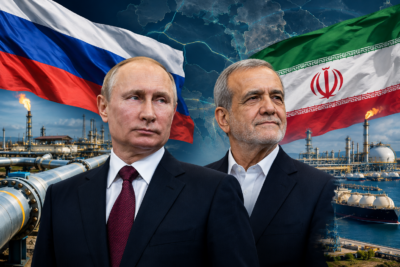
Iranian President Masoud Pezeshkian’s visit to Moscow for the eighth summit of the Gas Exporting Countries Forum (GECF) reinforces Tehran’s ambition to maintain a prominent role in Eurasian energy diplomacy and strengthen its cooperation with Russia.
The summit provides also the venues for the upcoming bilateral meeting between Pezeshkian and Russian President Vladimir Putin aimed at discussing trade, transport connectivity and regional geopolitical dynamics.
Rising tensions in the Middle East, including the risk of renewed confrontation involving Iran, the United States and Israel, add strategic significance to these exchanges, although the precise implications depend on developments in Washington-Tehran’s relations.
Moscow and Tehran share incentives to diversify export routes, develop alternative economic partnerships and reduce their exposure to Western restrictions. However, infrastructure constraints, investment requirements and differences in their commercial interests limit the extent to which bilateral cooperation can translate into coordinated influence over Eurasian energy markets.
Background
The eighth edition of the Gas Exporting Countries Forum (GECF) scheduled on 27 October 2026 in Moscow brings together major natural gas producers to discuss developments in the international gas market and opportunities for cooperation.
Russia chairs the meeting, while Pezeshkian’s participation underscores Iran’s position as a founding member of the forum, which held its first ministerial meeting in Tehran in 2001. GECF member states collectively account for approximately 70% of global natural gas reserves, giving the organisation a significant role in discussions concerning producer interests and international energy security.
Alongside the summit, Pezeshkian is expected to meet Putin to discuss bilateral cooperation and international affairs. According to the Iranian ambassador to Russia, Kazem Jalali, the agenda may include trade, energy, food security and the International North–South Transport Corridor (INSTC), which connects Russia and Iran with markets further south, including South Asia.
The summit also provides a platform for exchanges on investment, technology and the security of critical energy infrastructure. For Tehran, these issues align with efforts to strengthen national energy capabilities, diversify export routes and develop domestic technological capacity. For Moscow, closer engagement with Iran offers opportunities to reinforce economic connectivity across Eurasia and sustain cooperation with a major regional energy producer.
Analysis
Russia and Iran have a shared strategic interest in strengthening their positions in international energy markets, but their cooperation reflects pragmatic alignment rather than complete convergence of interests. Western sanctions and strained relations with the United States provide both governments with incentives to expand commercial relationships beyond traditional channels and develop alternative forms of economic cooperation.
Natural gas offers a potential basis for this alignment because both countries possess substantial reserves and seek to preserve their influence as energy producers. Nevertheless, resource wealth alone does not confer market power. Their capacity to influence international gas flow depends on export infrastructure, access to technology, financing and the ability to supply consumers at competitive prices, so, bilateral coordination could strengthen their negotiating positions, but it does not necessarily imply a common export strategy or coordinated pricing policy.
Infrastructure represents the principal constraint on the development of a more influential Russian–Iranian gas partnership. Geographic proximity and political cooperation cannot substitute for the pipelines, processing facilities, investment and transit agreements required to move gas towards prospective markets.
Iran must also address vulnerabilities affecting its energy infrastructure, while the risk of renewed military escalation in the Middle East creates additional uncertainty for long-term investment. A further confrontation involving Tehran, Washington, and Tel Aviv, could disrupt energy production, threaten transport infrastructure and increase regional risk premiums.
Such an outcome would complicate Islamic Republic’s efforts to expand its export capacity and could undermine the commercial foundations of bilateral cooperation. Moscow and Tehran therefore have incentives to explore infrastructure development and alternative export arrangements, but the scale and timing of any expansion will depend on financing, technical feasibility and the wider security environment.
The Eurasian implications extend beyond natural gas exports to transport connectivity and relations with regional partners. Russia and Iran occupy important positions along the INSTC, which seeks to improve commercial links between Russia, Iran and markets in South Asia. Greater coordination in transport and logistics could support broader economic integration, although the corridor does not itself provide the pipeline infrastructure necessary for natural gas exports.
More effective connectivity could nevertheless strengthen the commercial relationships that underpin energy cooperation and improve access to regional markets. Turkey and Central Asian states also form part of the wider strategic environment because their transport networks, energy policies and commercial partnerships influence the routes available to regional producers. However, these countries retain their own economic and foreign policy priorities.
Moscow and Tehran cannot assume that shared interests or geographic proximity will automatically translate into support for their initiatives, particularly where competing infrastructure projects, commercial considerations or relations with other external powers shape national decisions.
The strategic significance of Russian–Iranian cooperation will ultimately depend on whether political coordination produces tangible improvements in export capacity and market access. Both governments have incentives to pursue alternative routes and strengthen economic ties as they contend with Western restrictions and uncertainty in international markets. Yet they must also account for the bargaining power of importing countries, competition among suppliers and the high costs associated with new energy infrastructure.
Asian markets offer potential opportunities, but gaining a stronger position requires reliable supply, competitive pricing and commercially viable transport arrangements. Natural gas may retain an important role in regional energy systems, particularly where existing infrastructure and domestic demand favour continued consumption. However, assumptions that gas will necessarily outperform alternative energy sources over the long term would overlook differences in national energy strategies, investment conditions and the pace of technological change.
The most consequential indicator of progress will therefore be the emergence of concrete investment decisions, infrastructure agreements and demonstrable increases in commercially viable gas flows, rather than diplomatic declarations alone.
Conclusions
Russian–Iranian natural gas cooperation offers both countries an opportunity to strengthen their economic resilience and influence Eurasian energy dynamics, although infrastructure constraints and divergent commercial interests will limit the extent of their coordination.
In the short term, bilateral cooperation is likely to intensify through diplomatic consultations and efforts to advance energy and transport initiatives, subject to sanctions, implementation constraints and developments in US–Iran relations, particularly the risk of renewed confrontation.
In the medium term, continued pressure from Western governments could encourage Moscow and Tehran to develop alternative routes, infrastructure and commercial partnerships, potentially reshaping regional energy flows and bargaining relationships if they can secure the necessary investment and overcome technical and geopolitical obstacles.
