Executive Intelligence Snapshot
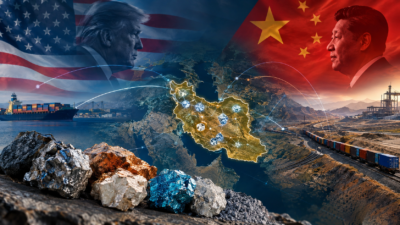
Iran has identified more than 20 new areas with potential rare-earth deposits and has made their exploration a national priority.
Although these discoveries do not yet constitute significant production capacity, they increase the country’s relevance to the growing US-China competition over critical minerals, in which control of reserves, processing capabilities and supply-chain infrastructure is becoming a strategic objective.
Context
Iran’s Geological Survey and Exploration Organisation (GSI), together with the Iranian Mining and Mining Industries Development and Renovation Organization (IMIDRO), identified potential rare-earth elements in more than 20 prospective areas across East and West Azerbaijan, Kurdistan, North, South and Razavi Khorasan, in addition to known areas including Sepehr-1 and Sepehr-2 in Marvast and the Bafq mining belt. Identified mineralisation includes lanthanum, cerium, neodymium and praseodymium, used in permanent magnets, electric vehicles, advanced electronics, wind turbines and defence systems.
Iran is already among the world’s most mineral-rich countries, with approximately 57 billion tonnes of proven reserves across 68 mineral types and more than 6,000 active mines. The country’s significant resource’s value is based at an estimated 27.3 trillion US dollars. Its critical-minerals profile extends beyond rare earths: Iran ranks highly in strontium, barite, iron ore, molybdenum, fluorite and lead, while also possessing substantial copper, zinc and titanium resources.
In March 2025, Tehran announced the discovery of 7,000 tons of antimony (chemically known as Stibium), a key element for sectors such as renewable energy and defence technology, as it continues its exploration programs.
In November 2025, the MP Materials Corp., the US Department of War, and Saudi Arabia’s Ma’aden signed a binding agreement to build the region’s first rare earth refining facility, anchored by a deposit the Saudi government ranks as the fourth most valuable rare earth reserve on earth.
In addition, US recent efforts to secure mineral resources in Ukraine (with a deal that provided nearly exclusive access, signed on 30 April 2025) illustrate the US objective of reducing dependence on Chinese-controlled critical-mineral networks.
China retains the world’s largest rare-earth reserves and a dominant position in mining, separation and processing. Beijing has also developed extensive infrastructure and economic networks across resource-rich countries, supporting access to strategic minerals and their associated supply chains. In light of ongoing competition, which has shifted to the Middle East, China is targeting Iran’s untapped assets to maintain its monopoly.
Why Does It Matter?
Iran’s emerging rare-earth potential should therefore be assessed within the wider US-China competition over critical-mineral supply chains rather than solely as a domestic mining development. Tehran’s prioritisation of critical minerals reflects the need to diversify beyond hydrocarbons, reduce exposure to sanctions and external supply disruptions, and secure domestic inputs for advanced industrial and defence capabilities.
The discovery of new deposits could eventually support non-oil exports and industrial development, but the immediate strategic value lies in their potential integration into global supply chains.
The Islamic Republic currently faces a substantial gap between geological potential and strategic capability: commercial exploitation requires further assessment, while large-scale rare-earth production depends on specialised separation technology, capital, technical expertise and reliable energy infrastructure. This is where China’s position becomes decisive. Beijing possesses capabilities that Iran lacks and has already established scientific cooperation with Tehran on rare-earth exploration and processing, including a joint research programme announced in August 2026.
Tehran has undertaken pilot extraction and separation activities, but there is no evidence that China is transferring technologies subject to its export restrictions. Chinese early engagement nevertheless provides Beijing with a low-cost strategic position from which to assess Iran’s resources and potentially shape future investment, processing and supply-chain arrangements if deposits prove commercially viable.
For the Middle Eastern Republic, cooperation offers access to capital, expertise and technology otherwise constrained by Western sanctions; however, it risks replacing dependence on Western suppliers with technological and financial dependence on China. This is particularly significant because strategic leverage in rare earths derives primarily from processing and downstream industrial capacity rather than from possession of ore alone.
Iran’s energy shortages further constrain its ability to establish large-scale processing facilities. China can mitigate some of these bottlenecks but cannot eliminate them, making the development of indigenous processing and industrial capacity the key determinant of Tehran’s strategic autonomy.
Western sanctions may reinforce the process: by restricting access to Western finance, technology and industrial partnerships, they increase the relative value of Chinese cooperation and may accelerate Iran’s integration into a China-oriented resource and technology network. The Islamic Republic’s parallel engagement with Russia and South-South partners, including Bolivia over rare-earth deposits, further indicates an effort to diversify external economic relationships, although these partnerships remain less developed than Beijing’s technological and industrial position.
The principal intelligence significance is therefore not the discovery of additional deposits itself, but whether Chinese involvement progresses from scientific cooperation towards financing, technology provision, joint ventures, infrastructure development or preferential access to future production. Such developments would indicate that Iran’s geological potential is being incorporated into a broader China-centred critical-minerals architecture.
Conversely, successful development of indigenous processing capacity would increase Tehran’s ability to use its mineral endowment as an instrument of economic resilience and strategic autonomy. The central question is consequently not whether Iran possesses valuable rare-earth resources, but who will control the capital, technology, processing capacity and infrastructure required to convert them into strategic power.
Outlook
Iran’s rare-earth potential is unlikely to generate significant geopolitical leverage in the short term. Its significance lies in the possibility that an emerging resource base will become integrated into the broader contest between Washington and Beijing over critical-mineral reserves and supply chains.
Monitoring Chinese financing, technology cooperation, joint ventures, infrastructure projects and access arrangements will provide the clearest indicators of whether Iran is developing an autonomous critical-minerals sector or becoming another node in China’s wider resource and processing ecosystem.
