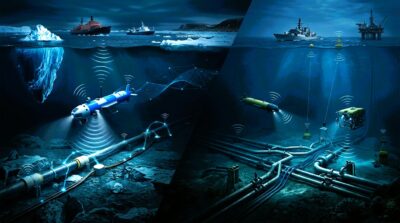
Executive Summary
Underwater surveillance systems reveal that a single submarine cable fault can leave communications intact while drastically increasing vulnerability to subsequent network failures.
In the western Mediterranean, several routes may depend on the same landing infrastructure or repair resources, while at Svalbard a first failure can leave services reliant on a single link until repairs are complete.
Drawing on public operator data, this report evaluates and compares the resilience of submarine telecommunications links from fault detection through service recovery.
Key Points
- New Mediterranean routes can increase capacity, but their value in a crisis depends on whether they bypass the same coastal and onshore points of failure.
- Svalbard’s 2022 cable fault shows how service can continue while an entire layer of redundancy is lost.
- Surveillance should be evaluated alongside the time needed to reroute traffic, mobilise repairs and restore spare capacity.
Background Information
In June 2026, Orange announced that the ViaTunisia segment of the Medusa cable system, between Marseille and Bizerte, was ready for service. The direct link adds a new connection between southern Europe and North Africa. Its contribution to resilience will depend on how operators use it, including whether traffic diverted from another cable can reach its destination through separate terrestrial infrastructure and whether there is sufficient spare capacity when demand peaks.
The Arctic comparison is mainland Norway’s connection to Svalbard. In January 2022, Norway’s Ministry of Justice and Public Security reported that one of two fibre links had failed and that communications continued normally. The incident showed the practical value of a second cable and the exposure that follows when a network has to operate on the remaining link.
Norway’s 2027 budget proposal says installation of a new mainland connection to Svalbard and Jan Mayen is under way, with operation expected from 2028. That timetable makes continuity on the existing system an immediate planning concern.
Analysis
This qualitative assessment considers two factors: how a single event could defeat existing safeguards and how much service would be lost. For a Mediterranean operator, the relevant test is whether apparently separate routes remain independent from shore to shore. Two wet routes can still depend on the same terrestrial junction, power supply or coastal access corridor. A fault confined to one cable may be absorbed through rerouting. A disruption at a shared landing or onshore node is a plausible high-impact scenario where routes converge, because it can disable several alternatives at once. ViaTunisia’s resilience value therefore depends on where its path diverges from other routes, including inland.
For Svalbard, loss of both links would have the most severe consequences. The available evidence supports treating this as a contingency to prepare for, with particular attention to the period after a first fault. For a remote link, mobilisation depends on the availability and transit time of a suitable vessel, compatible spares and a safe weather window for work on site. A satellite contingency can be tested against the bandwidth required to keep emergency coordination, essential government services and other priority users connected. The point of the test is to specify which services can run during an extended outage and what capacity must be reserved for them.
The two regions also call for different surveillance priorities. In the Mediterranean, operators and maritime authorities should focus monitoring on high-consequence coastal approaches where vessel activity and infrastructure exposure overlap. In the Arctic, the priority is to combine cable alarms with vessel information and targeted seabed inspection where conditions permit. Vessel tracks can help reconstruct a timeline and direct an inspection. Establishing the cause requires correlating those tracks with the time and location of the fault and, where possible, physical evidence. Operators should be able to reroute traffic and request repair capacity while that work is still under way.
In June 2026 the European Commission announced funding for regional cable hubs in the Mediterranean and Baltic and a €40 million call to improve repair capacity for submarine communications cables.
For the Mediterranean hub, an early test would be a cross-border exercise in which operators lose a landing area and compete for the same repair vessel. It would show where notification, access or contracting delays could extend the outage.
The International Advisory Body on Submarine Cable Resilience has identified both concentration and increased repair times as global challenges. For Arctic links, the equivalent exercise should assume adverse weather after a first fault and test how long priority traffic can be sustained before marine work can begin.
Over the next 12–24 months, three indicators would show whether vulnerability is falling: the volume of priority traffic that can be moved to a physically independent route, the time needed to secure a vessel and spares, and the time needed to restore a second working connection. These indicators should be recorded separately. Rerouting can restore customer service while the network is still operating without spare capacity. That interval matters to authorities deciding when to escalate a fault and to operators deciding whether to reserve capacity for essential services.
Conclusion
The Mediterranean priority is to demonstrate that alternative routes remain independent at sea and on land. The Arctic priority is to protect essential connectivity while repairs are pending, particularly if a first fault leaves only one working link.
Authorities and operators in both regions should rehearse the handover from fault detection to rerouting and repair. The exercise should end only when spare capacity has been restored.