Executive Intelligence Snapshot
The 13th Organisation of Turkic States (OTS) Summit will provide Turkey with an opportunity to strengthen its political leadership across the Caucasus and Central Asia through closer institutional, economic and transport cooperation.
The principal economic priorities concern trade expansion, foreign investment, energy cooperation and development of the Trans-Caspian International Transport Route (Middle Corridor). The transfer of the organisation’s chairmanship from Azerbaijan to Turkey, alongside the appointment of a new Secretary General, will shape its institutional priorities for 2027–2031.
The summit’s strategic significance will depend on whether participating states translate political commitments into funded infrastructure projects and measurable economic cooperation.
Background
The Organisation of Turkic States (OTS) summit will take place in Ankara on 30 October 2026 under the theme Turkic Century: Unity in Language, Thought and Deed. President Recep Tayyip Erdoğan will host the meeting, bringing together the leaders of the five OTS member states: Turkey, Azerbaijan, Kazakhstan, Kyrgyzstan and Uzbekistan. Representatives of observer states, including Hungary, Turkmenistan and the Turkish Republic of Northern Cyprus, are also expected to participate.
The agenda covers political cooperation, trade, investment, transport connectivity, energy, digital transformation, industrial cooperation and cultural relations. The leaders will review progress under the Turkic World Vision 2040 and discuss strategic priorities for the forthcoming period. The summit will also mark Turkey’s assumption of the OTS chairmanship from Azerbaijan and address the appointment of a new Secretary General. The participating leaders are expected to adopt the Ankara Declaration and additional documents concerning institutional development and regional cooperation.
The Middle Corridor represents one of the principal economic priorities because this transport route connects Central Asia with European markets through the Caspian Sea, Azerbaijan and Turkey. Its development could increase regional trade, improve logistics capacity and expand commercial links between participating states.
The 13th edition of the summit follows the previous event organised in Qabala (Azerbaijan), which marked the beginning of the Azerbaijani presidency, and confirmed Ankara’s ambitions towards the South Caucasus and Central Asia.
Why Does It Matter?
Turkey’s assumption of the OTS chairmanship reflects Ankara’s ambition to increase its influence across Central Asia and the Caucasus. The organisation offers a political platform through which Turkey can strengthen diplomatic relationships, promote economic cooperation and expand its regional presence. Its leadership also creates opportunities to advance Ankara’s position as a transport and energy connection between Asian producers and European markets.
The economic dimension remains closely connected to Turkey’s domestic interests. The expansion of regional trade, infrastructure investment and energy cooperation could attract additional capital into the Turkish economy and strengthen its logistics sector. Greater connectivity could also support construction, industrial production, transport services and energy infrastructure. However, the supplied sources do not establish the scale of potential investment or identify specific beneficiaries.
For Central Asian members, particularly Kazakhstan, Uzbekistan and Kyrgyzstan, the OTS provides an additional mechanism for expanding commercial relationships and improving access to external markets. Their participation supports regional cooperation without requiring exclusive alignment with Turkey. Their economic interests remain connected to several external partners, making diversified foreign relations an important consideration in their engagement with the organisation.
The Middle Corridor has the greatest potential to generate practical economic benefits. Improved transport connections could increase trade between Central Asia, Azerbaijan, Turkey and Europe. The route could also strengthen the regional importance of participating states by increasing their role in international logistics and energy transportation. Its commercial success will depend on infrastructure development, investment availability and effective coordination between the countries involved.
However, the creation of an economically independent Turkic bloc remains a longer-term ambition rather than an established outcome considering that the OTS member states do not currently demonstrate the economic capacity or institutional integration required to operate independently of major external economic partners. Their interests favour diversified commercial and diplomatic relationships rather than exclusive geopolitical alignment.
The organisation also faces institutional constraints. Differences in national economic priorities, investment capacity and infrastructure requirements could complicate the implementation of common projects. Turkey may seek stronger regional leadership, but the Central Asian members retain their own national interests and foreign policy priorities.
The security implications also deserve attention. Greater cooperation across the Caucasus and Central Asia could strengthen the participating states’ regional coordination and increase the strategic relevance of transport infrastructure. However, the supplied sources do not identify any proposed common defence arrangements, security commitments or collective military initiatives.
The summit should consequently be interpreted primarily as an economic and political initiative rather than evidence of a developing military alliance.
Outlook
Three possible developments emerge from the summit’s declared priorities.
- Continued institutional consolidation. Turkey could use its chairmanship to strengthen political coordination, establish new organisational priorities and promote closer cooperation under the Turkic World Vision 2040. The appointment of the new Secretary General will provide an indication of the organisation’s administrative direction.
- Economic integration. Progress on the Middle Corridor, energy cooperation and regional infrastructure could increase trade and investment opportunities. Successful implementation would strengthen Turkey’s position as a logistics hub and improve Central Asian access to European markets. However, the absence of confirmed financing commitments prevents a reliable assessment of the scale and timing of these benefits.
- OTS longer-term geopolitical ambitions. Greater economic cooperation could increase the collective bargaining power of participating states and support greater strategic autonomy. However, the current domestic situations and economic peculiarities of the organisation’s member states do not support the conclusion that the OTS is ready to operate as an independent political and economic bloc.
Overall assessment: The Ankara Summit represents an opportunity for Turkey to consolidate its leadership ambitions and advance economic integration across the Turkic world. The principal indicators of success will be the commitments contained in the Ankara Declaration, the new Secretary General’s priorities and the implementation of infrastructure, energy and trade initiatives during the 2027–2031 period. Until these commitments produce measurable economic results, the OTS should be regarded as an emerging instrument of regional cooperation rather than an independent geopolitical bloc.
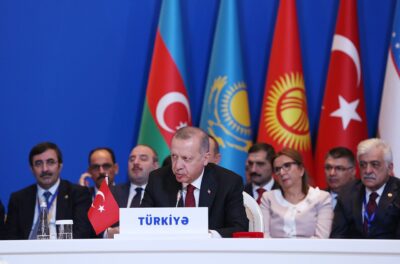
*Cover image: The Turkish President Recep Tayyip Erdoğan during the 7th Summit of Cooperation Council of Turkic-Speaking States in Baku (Credits: President.az, CC BY 4.0, via Wikimedia Commons
