The Astrakhan region has historically served as a significant centre of Russian presence in the Caspian region for centuries. Since the late 20th century, following the geopolitical shifts caused by the collapse of the Soviet Union, Astrakhan’s role in Russia’s Caspian policy has acquired considerable prominence.
In an ever-evolving geopolitical landscape, the perception of a waning United States influence in the Middle East has gained momentum. This shift has sparked debates about the extent of the US disengagement and the emerging roles of other global players, particularly China.
The forthcoming “United States + Central Asia” summit, scheduled for mid-September 2023, stands as a resounding affirmation of the region’s enduring geopolitical significance
Iran’s membership in BRICS could shape novel prospects for Tehran’s foreign policy and economic strategy, solidifying the growing geopolitical paradigm of a multipolar world, where nations like Russia, China, Iran, and India endeavor to provide a counterbalance to Western influence.
The Republic of Artsakh, also known as Nagorno-Karabakh, has found itself embroiled in a dire humanitarian crisis because of the Azerbaijan blockade imposed since December 2022.
Turkey-Iran relations have always been discontinuous, characterised by cooperation on the diplomatic level, alternating with opposite geopolitical needs and foreign strategies. Nowadays, especially in the Middle East and the Caucasus, Pan-Turkism and strategic needs drive Ankara-Tehran relations.
Chinese Minister of Defence’s visit to Russia and Belarus reflects the cooperation between these countries in the realm of defence and highlights the significance of multilateral discussions in ensuring global stability and security.
SpecialEurasia met in Sukhum Irakli Tuzhba, Deputy Minister of the Foreign Affairs of the Republic of Abkhazia, to delve into Abkhaz domestic and foreign politics and investigate future developments of the country.
The first-ever trilateral summit between Turkmenistan, Tajikistan, and Uzbekistan organised in Ashgabat underlined the desire of these three Central Asian republics to cooperate in different fields to guarantee regional stability and interconnection.
The developing geopolitical dynamics in the Middle East, particularly concerning Iran’ strategy and cooperation with Syria in the defence and military weapons sectors, have sparked significant shifts on the regional chessboard.
Turkey’s engagement with the Association of Southeast Asian Nations (ASEAN) has evolved into a strategic endeavour, marked by Ankara’s quest for deeper economic, diplomatic, and cultural connections.
Today, the countries of Central Asia have closer ties than ever before, and these bonds are expanding. An example of this is the summits that the states are holding with Central Asia and the frequent state and working visits by Central Asian leaders to each other’s countries.
Given the significance of the North Caucasus region in the intricate Eurasian geopolitical landscape and the potential role of indigenous communities within Russian society, SpecialEurasia decided to visit the Republic of Karachay-Cherkessia to attend the Forum of Indigenous Peoples of the Russian Federation.
In a strategic move amid shifting geopolitical dynamics, Kyrgyzstan and Iran are attempting to expand their trade and economic ties, driven by Bishkek’s pursuit of alternative transit routes and access to Iranian oil products, and Tehran’s strategic outreach towards the Central Asian republics considering Western sanctions and recent developments in the Eurasian region.
The inaugural “Central Asia + GCC” Summit held in Saudi Arabia marks a significant milestone in fostering interregional cooperation between the Gulf countries and Central Asia.
In today’s interconnected world, where nations are increasingly intertwined through political, economic, and social ties, it becomes crucial to comprehend and assess the concept of geopolitical risk.
After our visits to Astana, SpecialEurasia published a report on the future prospects of Kazakhstan, which analysed the country’s domestic and foreign policy as well as the local society and culture.
Uzbekistan recently held its presidential elections, and the re-election of Shavkat Mirziyoyev has significant importance for the country. Mirziyoyev’s victory ensures stronger governance, allowing Uzbekistan to continue its process of reforms, economic diversification, and foreign policy initiatives.
Iran’s admittance to the Shanghai Cooperation Organization (SCO) as a full member is a noteworthy step that has greatly impacted the geopolitical arena of the region.
This analysis investigates the economic hardships experienced by Mongolian herders and explores the profound influence of global forces on their traditional way of life, shedding light on the intricacies of their livelihoods amidst an ever-changing landscape.
The recent mutiny led by the Private Military Company (PMC) Wagner in the Russian Federation brought forth a critical moment for President Vladimir Putin. During this crisis, Putin garnered the support of the Russian army, regional governors and heads of states, reaffirming his powerful position in the political and military landscape.
Recent developments in Russia have brought attention to the involvement of the Wagner Private Military Company (PMC) in an attempted armed rebellion or mutiny. The incident, which unfolded on the evening of June 23rd, 2023, has triggered a series of reactions and measures by key institutions, leaving the country on high alert.
Iran’s Foreign Minister, Hossein Amir-Abdollahian, recently embarked on a three-day diplomatic tour of key Arab nations in the Persian Gulf. With a focus on economic collaboration, his visit to Qatar, the United Arab Emirates, Kuwait, and Oman marked a significant step towards enhancing relations with Iran’s southern Arab neighbours.
The recent visit of the North Caucasian Federal University (NCFU) delegation to Iraq marked a significant step towards fostering cooperation between the Russian North Caucasus and the Middle Eastern country.
Qatar’s recent diplomatic foray into Central Asia by the Emir Sheikh Tamim bin Hamad Al Thani marked a significant step in the nation’s regional foreign policy.
At SpecialEurasia we had a profound realisation regarding the significance of relying on an analytical framework in geopolitical analysis rather than attempting to consume an overwhelming amount of news in the realm of geopolitical forecasting.
The St. Petersburg International Economic Forum (SPIEF) serves as a significant milestone in Russia’s foreign policy and economic strategy.
This report highlights the reasons the North Caucasus remains important and necessitates ongoing monitoring and provides some future scenarios about the region.
Critical thinking might support geopolitics by providing a framework for analysing and evaluating arguments about power and place. By utilising frameworks for critical examination, analyst can investigate geopolitics and uncover the concealed political powers of geopolitical comprehension.
The recent meeting between Russian Foreign Minister Sergei Lavrov and Tajikistan’s President Emomali Rahmon has unveiled the Central Asian republic’s strategic role for Moscow’s foreign policy in the region in defence, security, economy and social sectors.
During the Astana International Forum, SpecialEurasia met with Roman Vassilenko, Deputy Minister of Foreign Affairs of the Republic of Kazakhstan, to discuss Kazakh foreign politics and regional dynamics.
On May 29th, 2023, SpecialEurasia representatives met with an Uzbek delegation at the Eurispes to better understand the Central Asian republic’s strategic role and investment opportunities and possibilities of cooperation between Rome and Tashkent.
SpecialEurasia will participate in the Astana International Forum 2023, as part of our ongoing commitment to monitoring and evaluating emerging markets and investment prospects in strategic countries like Kazakhstan and the broader Central Asian region.
The inauguration of the Analytical Centre for China Studies in Bishkek marks a significant milestone in China-Kyrgyzstan cooperation, underscoring Beijing’s strategic approach towards the Central Asian republic.
The recent Iran-Turkmenistan deal on natural gas export emerges as a pivotal agreement, poised to both fortify Tehran’s energy strategy and bolster Ashgabat’s endeavours towards economic diversification by expanding its trade partners.
On May 30th, 2023, SpecialEurasia Managing Director, Silvia Boltuc, attended the event “Bahrain yesterday and today” organised by Laila Khrais on behalf of the Assadakah and Welcome Association Italy.
To counter a rising China, the U.S. should revise its definition of the Indian Ocean area of responsibility, and formulate a plan dedicated specifically to the Bay of Bengal and Myanmar.
The first China-Central Asia Summit and the second EU-Central Asia Economic Forum highlighted Beijing and Brussels’ interests and competition in the region.
The North Atlantic Treaty Organization (NATO) suffers from disproportionate financial burden-sharing., exacerbated by the fact the NATO has expanded its area of operations beyond the borders of NATO countries. A dedicated NATO bank could be the solution.
The KazanForum 2023 and Zelensky’s visit to Jeddah during the Arab League summit underlined how strategic is the Muslim world for Russia and Ukraine.
In this paper published in Geopolitical Report ISSN 2532-845X Vol. 2 Year 2023, the author examined the current status of Tehran-Tbilisi relations and assess possible future geopolitical scenarios concerning these two actors and the regional Caucasian dynamics.
The KazanForum 2023 and the “China-Central Asia” Summit definitely emphasise Kremlin and Beijing’s strategies in Eurasia and the Islamic world’s strategic areas in time of confrontation with the West.
Il vertice Armenia-Azerbaigian che si è tenuto a Bruxelles permette di concentrare l’attenzione sulla questione dei confini nazionali armeni e azerbaigiani la cui soluzione dovrebbe portare alla stabilità e non creare ulteriori tensioni regionali.
On the surface, the Ukraine war appears to be a conflict between two primary actors, namely, the Russian Federation and the sovereign nation of Ukraine. On deeper analysis, however, it can be said that the Ukraine war is an example of great power competition.
SpecialEurasia, in partnership with MInter Group SRL, Notizie Geopolitiche, and Mondo Internazionale ASP, published Geopolitical Report ISSN 2532-845X Volume 2 Year 2023 focused on Iranian strategy in the South Caucasus.
SpecialEurasia ha incontrato S.E. Mohammad Reza Sabouri, Ambasciatore dell’Iran in Italia, per discutere le dinamiche attuali interne e in politica estera della Repubblica Islamica dell’Iran.
SpecialEurasia met with the Ambassador of Sudan to Italy, H.E. Sayed Altayeb Ahmed, to discuss further the recent events that have shaped the Sudanese domestic politics and stability and try to assess future consequences and developments.
The upcoming Turkish elections might affect Ankara-Tehran relations if the opposition leader Kemal Kilicdaroglu will defeat the president Recep Tayyip Erdogan and, thus, change domestic and foreign policies.
Turkmenistan accomplished the mission to export its natural gas to Pakistan through Afghanistan, an economic goal that Ashgabat aimed to reach to diversify its exports and trade partners and increase the revenue.
SpecialEurasia met in Rome H.E. Julianne Smith, the US Ambassador to NATO to investigate the conflict in Ukraine, the Chinese threat, and global challenges such as terrorism, issues which the Atlantic Alliance will discuss at the NATO summit in Vilnius in July 2023.
Mongolian Foreign Affairs Minister’s upcoming visit to China emphasised the relations between Ulaanbaatar and Beijing and the Chinese strategy to increase its influence in the Asian country because of strategic position and significant natural resources.
Kazakhstan’s desire to increase exports to Iran might hugely impact geopolitical dynamics in Eurasia, considering Astana’s desire to diversify and enhance its trade and economic partners to decrease Russia and China’s influence and Tehran’s necessity to overcome Western sanctions.
The construction of the Dushanbe-Kulma highway, thanks to the Chinese investment, might support the interconnection between the Gorno-Badakhshan Autonomous Region (GBAO) and the Xinjiang Uyghur Autonomous Region (XUAR) with the final goal of improving local economies and stabilising these two strategic regions.
Open Source Intelligence (OSINT) is a crucial aspect of modern-day geopolitics because it provides timely and accurate information to inform decision-making processes. By leveraging various open sources such as social media, news outlets, and other publicly available data, intelligence agencies can detect emerging trends and patterns in all aspects of life, including political, economic, social and technological domains.
In the last months, the South Caucasus has again experienced regional turbulence. While there have been protests in Georgia over a controversial draft law that would have required some organisations receiving foreign funding to register as “foreign agents”, Armenia and Azerbaijan might be again on the edge of an escalation involving the CSTO and, therefore, Russia.
The South Caucasus and the Middle East have long been at the epicentre of geopolitical, ideological and ethnic tensions. While the Israel-Iran hybrid war is experiencing a new momentum, ongoing tensions between Armenia and Azerbaijan might open a second front in which both Tel Aviv and Tehran might be involved.
Increased Russian investments in Adygea confirm the Kremlin’s strategy to implement the North Caucasus’ socioeconomic development and transform the region into a logistics hub supporting the diversification of Russian exports.
Iran has been making great strides towards bolstering its economy and proving itself an attractive investment destination. The key factors driving the country’s economic growth are the Iran Special Economic Zones and the Iran Trade-Industrial Free Zones.
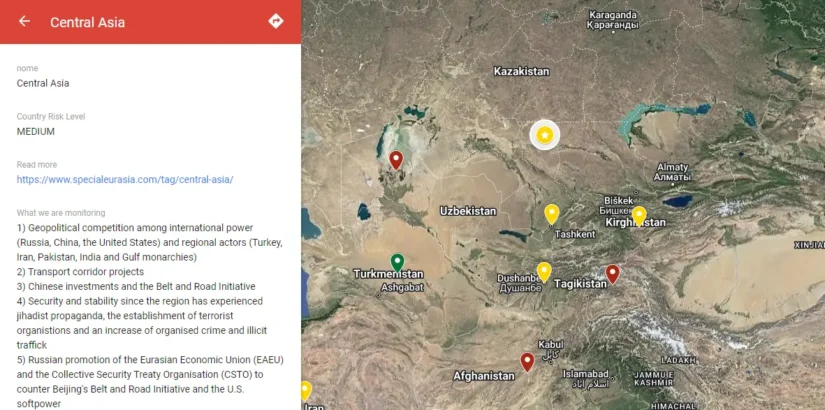
At SpecialEurasia, we consider fundamental our Monitoring & Risk Analysis map that underlines the Geopolitical Risk Level for each country linked to our monitoring articles, reports and special projects.
Recent negotiations between Saudi Arabia and Uzbekistan on investment cooperation confirmed Riyadh’s strategy in Central Asia based on financial support to local governments’ infrastructural projects and humanitarian aid.
Questa ricerca si pone come obiettivo quello di analizzare la competizione sino-statunitense nella regione dell’Asia-Pacifico prestando particolare at-tenzione alle loro strategie nel settore militare.
In questa ricerca verrà analizzato il trinomio cambiamenti climatici, conseguenze sulla popolazione e terrorismo in Asia destinato, se la comunità internazionale non provvederà a fermare questo trend, ad essere presente nelle agende internazionali negli anni a venire.
Obiettivo di questo paper è quello di valutare il rischio geopolitico dell’Asia centrale prendendo in esame le dinamiche geopolitiche regionali e le problematiche che potrebbero comportare destabilizzazione e mancanza di sicurezza.
The Gorno-Badakhshan Autonomous Oblast (GBAO) might be considered one of Central Asia’s most strategically important areas, attracting multiple global powers’ attention. Under Dushanbe’s control, the region has experimented with the confrontation between the central authority and the local population.
Questa ricerca mira ad analizzare gli sviluppi geopolitici centroasiatici prendendo in considerazione i recenti eventi che hanno influenzato lo scacchiere eurasiatico come lo scontro tra la Russia e l’Occidente, il confronto tra Stati Uniti e Cina e la volontà di emergere come potenze regionali di Turchia, India e monarchie del Golfo.
Geopolitical Report ISSN 2785-2598 Volume 29 Issue 8 Author: Guido Keller India and Turkmenistan discussed expanding cultural cooperation confirming New Delhi’s strategy in Central Asia and Ashgabat’s desire to diversify and enhance its collaboration and ties with regional actors.
Le elezioni parlamentari in Kazakhstan potrebbero dare stabilità al paese e completare il processo di riforme avviato lo scorso anno volto a garantire sicurezza interna, supporto al Governo e al presidente così come a rassicurare gli investitori sul mercato interno kazako.
SpecialEurasia discussed with Alexandr Sharov, General Director of the transport company LLC Neftekhimtrans, Group of companies Rusiranexpo, the current geopolitical significance of the INSTC and possible future developments and impact in the Eurasian strategic chessboard.
Upcoming parliamentary elections in Kazakhstan mark the last step for the country’s complete reformation based on modernisation and democratisation according to the new path promoted by Kazakh President Kassym-Jomart Tokayev.
SpecialEurasia, MInter Group srl e Mondo Internazionale APS organizzano la Spring School 2023 con l’obiettivo di erogare corsi di formazione di analisi geopolitica su dinamiche e tematiche inerenti alla scacchiere strategico internazionale.
Russia-Uzbekistan-Kazakhstan’s ‘trilateral gas union’ might represent geopolitical leverage in favour of Moscow and Beijing because it might simultaneously satisfy the Chinese energy market’s needs and support the Russian and Chinese foreign policy in Central Asia.
Iran and Saudi Arabia, longtime regional rivals, have agreed to resume friendly diplomatic relations and reopen their embassies after Chinese-led negotiations in Beijing. The two governments announced the agreement via their respective state media agencies and China’s Xinhua News Agency.
The United Arab Emirates (UAE) and Eurasian Economic Union (EAEU) member countries discussed the establishment of a free trade zone, which might become a significant step in strengthening Emirati financial and economic presence in the Eurasian geopolitical chessboard and support Russian financial strategy to contrast Western sanctions’ consequences.
Considerando l’importante ruolo nello scacchiere geopolitico internazionale, SpecialEurasia ha preso parte all’evento di premiazione dell’ambasciatrice della Mauritania in Italia S.E. Zeineb Ely Salem per approfondire la conoscenza del paese e dell’importanza della diplomazia femminile nel nord Africa arabo.
SpecialEurasia published the document “Central Asia Weekly Intelligence Brief February 27th– March 2nd, 2023”, whose purpose is to highlight key geopolitical topics related to Central Asia affecting the international arena and organisations around the globe.
Antony Blinken’s visit to Astana stressed Washington’s interests in Central Asia since the region has played a vital role in the Eurasian geopolitical chessboard, especially after the beginning of the Ukraine conflict.
On Tuesday, February 21st, 2023, SpecialEurasia, Mondo Internazionale, Opinio Juris – Law & Political Review and MInter Group srl organised the online webinar “A year of Ukraine conflict: insights, geopolitical analysis, possible future developments” to analyse the last year of fighting in Ukraine contextualising this event in the Eurasian geopolitical chessboard.
Following the allegations of Iran being involved in the Ukrainian conflict by delivering weapons to Russia, Tehran has been under severe international pressure and sanctions. Given its good relationship with Iran and its neutral foreign policy, Oman might emerge as a strategic regional mediator and help resolve critical issues such as the revival of the Iranian nuclear deal and the dispute between Iran and Saudi Arabia.
Il forum economico “Russia – Mondo islamico” che si svolgerà a Kazan nel maggio 2023 sottolinea l’importanza che il mondo musulmano ha nella politica estera russa, in special modo a seguito delle imposizioni delle sanzioni occidentali che hanno spinto Mosca a riversare i propri interessi su mercati alternativi.
In the context of the Ukraine conflict and the changing geopolitical scenario in Eurasia, Islamabad denied the ammunition supply to Ukraine to avoid any possible deterioration of the relations with the Russian Federation, which is actively involved in promoting the Pakistani energy and logistic markets.
E’ online il secondo numero di Diplomacy. Strategic Approach to Global Affairs, rivista di affari internazionali facente parte delle pubblicazioni di SpecialEurasia realizzata da MInter Group srl che si pone come obiettivo quello di analizzare tematiche inerenti la geopolitica, la sicurezza, l’ambiente e la società.
Since Uzbekistan and Vietnam are expanding their economic cooperation and relations, Tashkent might promote its role in Central Asia as a regional interconnector. At the same time, Hanoi might support its foreign policy by establishing a strategic partnership with international and regional actors.
The meetings between Tajik representatives and officials from Qatar and the Islamic Development Bank highlighted Tajikistan’s strategy to attract foreign investments from the Arab-Muslim world and Doha’s desire to play a significant role in the local and regional market.
Considerando la posizione geostrategica che la Cambogia detiene nella regione del Sud-Est Asia e il rapporto economico che lega Phnom Penh a Pechino, la Repubblica Popolare Cinese ha sviluppato una strategia volta a rafforzare i legami e trasformare lo Stato cambogiano in un elemento fondamentale della sua politica estera regionale.
Geopolitical Report ISSN 2785-2598 Volume 27 Issue 4 – The recent meeting between Kazakh and U.S. representatives in Washington stressed Astana’s desire to balance its foreign policy between the West, Russia, and China, and the White House strategy to increase its presence in the Central Asian republic.
The recent Russia-Turkmenistan business forum attended by the Russian Prime Minister Mikhail Mishustin confirmed Kremlin’s strategy in Central Asia and Moscow’s desire to deepen economic and diplomatic cooperation with Ashgabat to avoid any further external interference by the European Union, China, or the United States.
The Kremlin’s project to evaluate the opportunity to implement Islamic banking in Russia might support the national economy, attract foreign investors from the Arab-Muslim world, and counter the consequences of Western sanctions imposed against Moscow due to the Ukraine conflict.
The Russian invasion of Ukraine has sparked economic sanctions, which are meant to cripple the economy while detracting from Russia’s ability to wage war. This paper will analyse the sanctions’ impact, the war on the Russian economy and possible future implications.
In a phone call, Tajik President Emomali Rahmon discussed bilateral relations with Kyrgyz President Sadyr Zhaparov and the delimitation of the common border necessary to resolve Tajikistan-Kyrgyzstan territorial disputes which in the past have erupted in border clashes.
The pandemic crisis, the interruption of the supply chain, and the war in Ukraine with soaring fuel prices and shortages of flour and corn have put a strain on Egypt’s economic stability. In 2022, the Egyptian government adopted measures which resulted in harsher conditions for companies and local citizens, which Cairo currently hopes to overcome with the support of the International Monetary Fund.
In 2023, military escalations, domestic political turmoil, and economic crises might increase Iran and the Caucasus’ geopolitical risk and threaten regional security, whose consequences might broadly destabilise the Eurasian strategic chessboard.
In 2023, foreign actors’ interests, terrorism, authoritarianism, and economic slowdown might threaten Central Asia and AfPak’s security and stability and increase regional geopolitical risk.
SpecialEurasia wants to celebrate the last year of activities with our friends, partners, sponsors, and followers, hoping to begin the following year with the same commitment. In 2022, we have improved our activities and projects and affirmed our presence in Italy and abroad thanks to webinars, official visits, meetings, and training courses.
This report stems from the research project titled “Malicious Use of Artificial Intelligence and Challenges to Psychological Security in Northeast Asia” (21-514-92001) and jointly funded by the Russian Foundation for Basic Research (RFBR) and the Vietnam Academy of Social Sciences (VASS).
Recent violent attacks in Iraq demonstrated that Islamic State continues to pose a severe threat to civilians and security forces, even though the government declared its ‘total defeat’ in 2017.
Since Tehrik-e-Taliban Pakistan (TTP) ended the ceasefire with the Pakistani Government, security has worsened in the country. Recent violent attacks in Pakistan and militants’ seizure of the Counter-Terrorism Department (CTD) compound in the Bannu district have also alarmed neighbouring countries and foreign investors who are worried about future Pakistani stability.
Geopolitical Report ISSN 2785-2598 Volume 26 Issue 3 – SpecialEurasia met with the Serbian university professor Marija Djoric to discuss the current security situation and terrorist threat in the Balkans.
Zhaparov’s official visit to Abu Dhabi confirms Kyrgyzstan’s interest in developing an economic partnership with the United Arab Emirates and the Emirati desire to enhance its presence and influence in the Central Asian republic.
Chinese President Xi Jinping is paying an official visit to Saudi Arabia to affirm Beijing’s influence in the Gulf and contrast the U.S. presence in the region.